


Greetings Deeists,
My birthday is coming up on the 27th… Please use this “Birthday Month Special” coupon to help me move up the leaderboard:

YOU’RE A STAR, YOU’RE A STAR, YOU’RE A GREAT BIG SHINING STAR
I promised myself that I wouldn’t do this but it’s killing me.
Predicting trends is one of my talents, as up my own ass as that sounds. My hit rate is high. There’s no formula, really — it’s just one of those things where you know it when you see it and I tend to know it. But I’m like a broke psychic, I can’t seem to get any of that luck to rub off on myself.
Anyway, naturally, I’ve been kicking myself every single day for fumbling an interview with Clavicular — well before he blew up. He was willing to talk! We took it to email! And then I was the flake, he got huge, and now, I, too, am just a random jester trying to clout vampire him. Trust your gut, folks, or you may live to regret it.
More on him below. But first:
WAS JEFFREY EPSTEIN SATANIC?

This past week, I’ve been doing a deep dive into Satanism in all its manifestations.
When people call the “elites” Satanic — Epstein being the most salient example here — what they actually mean is something closer to Kabbalah, Hermeticism, Freemasonry, or some combination of all three. Not Satanism, which is a phenomenon recent of the 20th century1, but some version of hidden esoteric knowledge that justifies their power and their appetite for more of it.
First of all, none of those traditions are “Satanic,” and none of them involve eating or raping children or whatever else people have convinced themselves is happening. (They’re not Frankists, either, by the way, don’t try me, conspiratards!) Western esotericism has a long, well-documented history, and the conspiracy version bears no resemblance to it. That said, I don’t think elites are secretly practicing occultism, either.
This might seem like a pedantic point given that disclaimer, but actual Satanism — the real thing, not the conspiracy theory — skews far more downmarket than people assume.
The most dangerous Satanic-adjacent network operating today won’t be found in Silicon Valley, Manhattan, or on a private island. It’s on Discord and Roblox. You can read more about it on my friend Bx’s Substack, here.
None of this is to let Epstein and co. off the hook. I’m not much of an Epstein apologist and I definitely believe the ultra-wealthy have the potential to be up to some devious things, not limited to coordinated sexual assault and, uh, “Dubai chocolate.”
I just don’t think it has anything to do with the occult or Satan. At least, not explicitly.
THE SCRAMBLE TO REDEFINE WOKENESS
A cluster of recent essays have each tried to name the next phase of woke politics, and each one has arrived at a different answer. Valerie Stivers gave us “Woke 2.0.” Luke Winkie published an explainer on “Dark Woke.” Kat Rosenfield diagnosed “Disneyfied” protest culture. They don’t agree on what the new thing is, only that the rebrand has arrived.
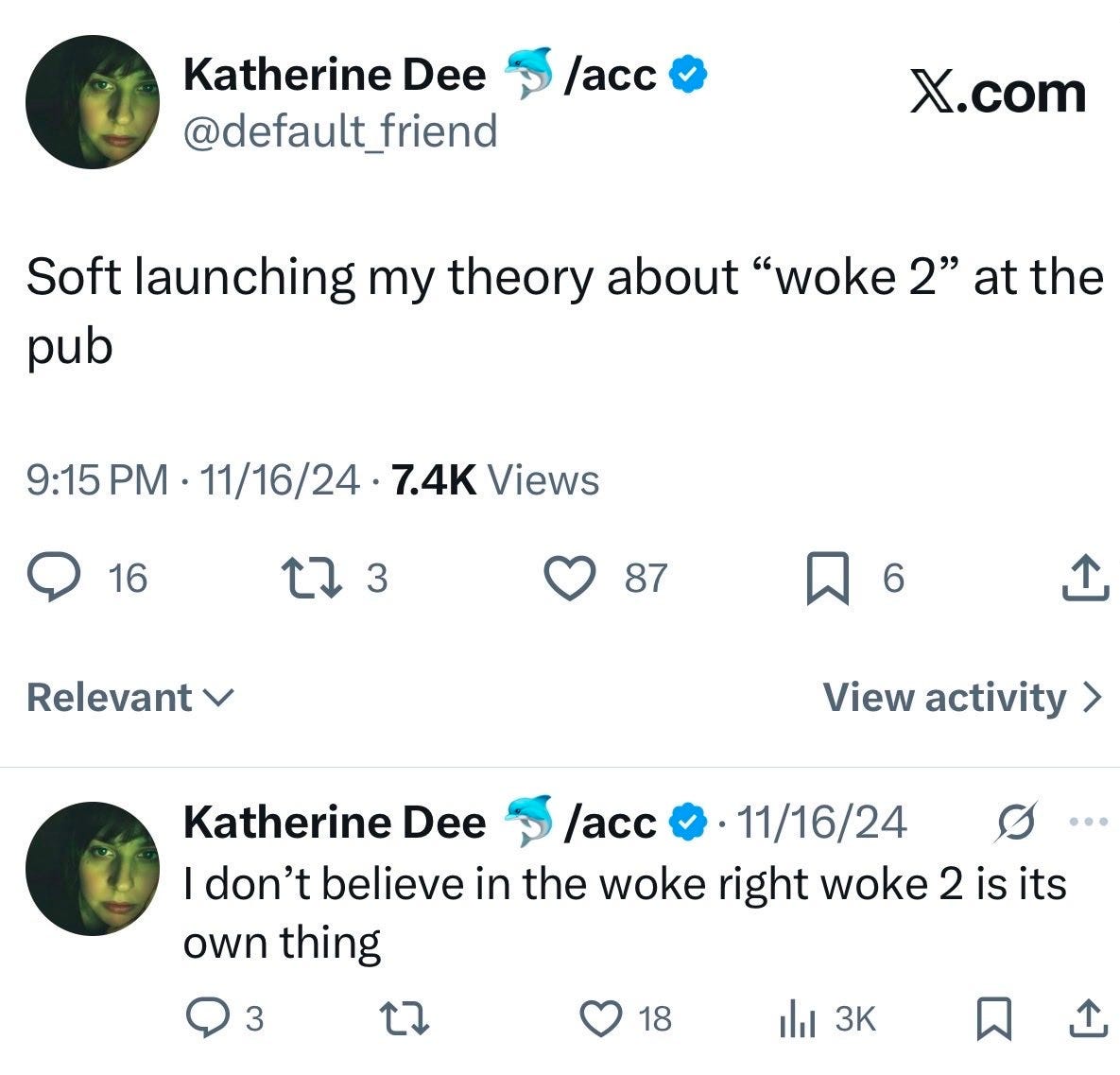
If there’s a story here, and my instinct is there isn’t, it’s the definitional scramble itself. The interesting question isn’t what woke has become (or, indeed, if it’s become anything at all).
It’s why so many people need it to have become something new, and why naming the new thing has become a cottage industry in its own right. There’s a reason these pieces keep getting written: the writer who successfully names the moment gets to be the person who saw it first (and might even land a book deal out of it). That incentive is doing as much work as any of the analysis.
Let’s start with Stivers, whose UnHerd piece makes the strongest case. She argues that the anti-ICE protests represent a purified evolution of the #Resistance, one that has shed the yard signs, the gender theory, the anti-racism consciousness raising. What remains is “militant action” and “individual, atomized, and newly dangerous” rage2: protesters blocking ICE, doxxing agents, sending death threats. Her sharpest observation is about the movement’s martyrs.
The faces of the movement are Renee Good and Alex Pretti rather than any of the 32 people who reportedly died in ICE custody in 2025, which she reads as confirmation that woke-ism was always a vehicle for the professional class to feel good about itself.
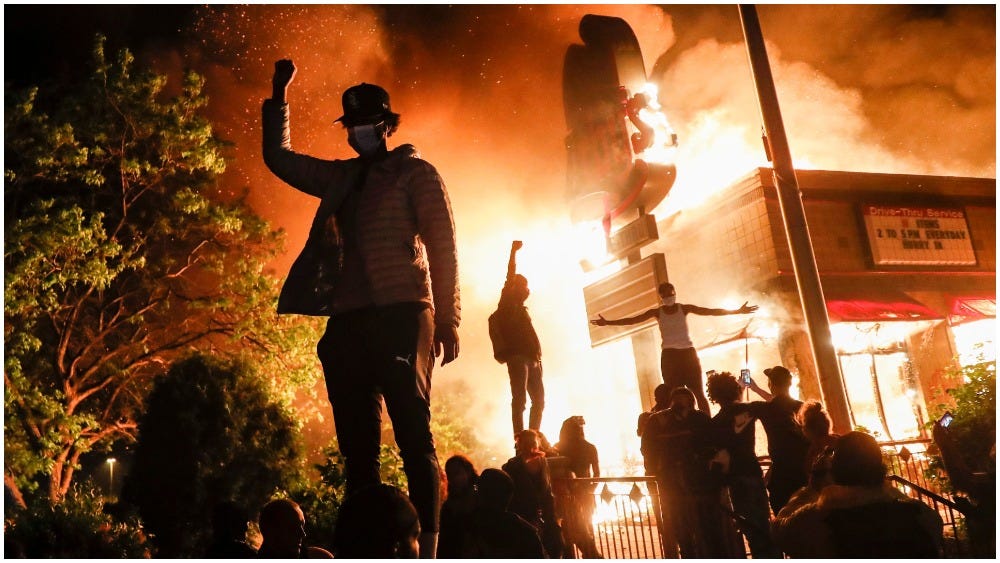
The central claim, though, that this is “more vicious” than 2020, doesn’t survive contact with anyone who was present at the 2020 protests, which famously included arson and looting. I myself witnessed people destroy a community theater, and to this day, I wonder what the hell that was about.
Protests aside, though, among the biggest complaints people had with “Woke 1.0” — even before the 2020 crescendo — was just how personal and searing it was. There was a, I think justified, sense that we were living in a political correctness panopticon that offered no pathway for redemption, hence the eventual advice to “never explain and never apologize to the cancellation mob.” It was precisely this viciousness that created the media ecosystem both Stivers and I have made nice careers writing in.
So if this “new” version is defined by personal viciousness, what exactly changed?
Then there’s Winkie’s “Dark Woke” piece, which describes a social covenant allowing liberals to be cruel to conservatives. Being mean to your political opponents is not new, though to be fair to Winkie, I know what he means. He’s not just talking about being mean. It’s a special kind of Millennial-flavored cruelty, the balls to finally just call someone a big fat retard, no throat-clearing required.
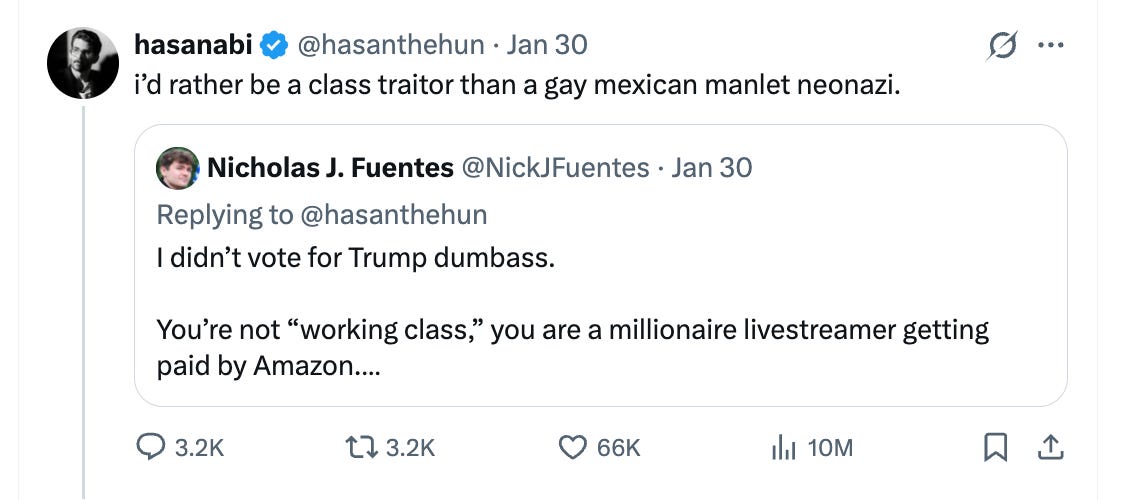
Still, calling it “Dark Woke” doesn’t make it meaningfully different from the Dirtbag Left of a decade ago. At least, not to my mind.
Rosenfield’s Free Press essay, “Minneapolis Isn’t a Movie,” argues that anti-ICE demonstrators have wandered into real danger because they understand political conflict as spectacle, a movie they can star in without consequences. The key evidence is Rebecca Good’s scream after her wife was shot: “Why did you have real bullets?” Rosenfield reads this as proof of delusion, that the Goods thought they were in a movie. But as Rayne Fisher-Quann put it in her critique of this piece (which, I should say here, I thought was too scathing — I don’t share her dislike of Rosenfield, who I read, respect and count among my friends), anyone familiar with the well-documented use of rubber bullets and other less-lethal alternatives in crowd control, a practice with an extensively reported history in Minneapolis specifically, would recognize this as a desperate question about why live rounds were used instead.
I think the Stivers and Rosenfield pieces share a methodology problem. They’re building theories from social media clips. It reads as though Stivers constructs her case almost entirely from the same screen-mediated material she accuses the protesters of being consumed by. Rosenfield mistakes a woman’s anguish for naïveté because she is, presumably, unfamiliar with the realities of protest culture.
But where I diverge from a critic like Fisher-Quann is that I don’t think these are personal failings of either writer. That’s just the nature of reporting these days — and that’s not handwaving, either. We have to consider that both women are making a living from their writing.
Writers are working on tight turnaround times, often hours and not days, and don't have the option of in-depth reporting for their 800-to-1,200-word op-eds. Especially freelancers.
It's not even the publications’ fault, really (though, for obvious reasons, I’m certainly more amenable to that argument than the alternative). It's the nature of an industry we all know is shrinking. There’s neither the time — the public's attention span is short — nor the money to send somebody like Rosenfield out to Minneapolis if she's not explicitly doing investigative reporting, a genre that is rare even at the best-funded publications. To turn the critical eye to Fisher-Quann for a moment, whose piece I enjoyed and thought made several important points: her critique would land harder if it accounted for the fact that most writers in this space simply don't have the luxury of time or resources for the kind of reporting she's implicitly demanding. In a just world, we would absolutely have it. We don't live in a just world, though, and you can’t hold individual writers responsible for the economics of the industry3.
At any rate, I do think the scramble to name is worth interrogating. None of this means nothing is changing – I’ve written about similar changes myself. But a lot of it is branding work, and it’s not always usefully deployed.
There is no Woke 2.0 – yet. There are, however, people who need there to be one.
GRINDR → TINDER

Looksmaxxing feels like rebranded gay culture, and the community itself will tell you as much. A Looksmax.org thread titled “looksmaxing is gay” argued the entire movement descended from gay culture in the ‘80s and ‘90s, and that even Tinder was a spinoff of gay dating apps (which is obviously true, I remember when my gay friends had Grindr and all I had OkCupid). Both communities landed on the same toolkit independently: meth, SARMs, grey-market peptides, anabolic steroids.
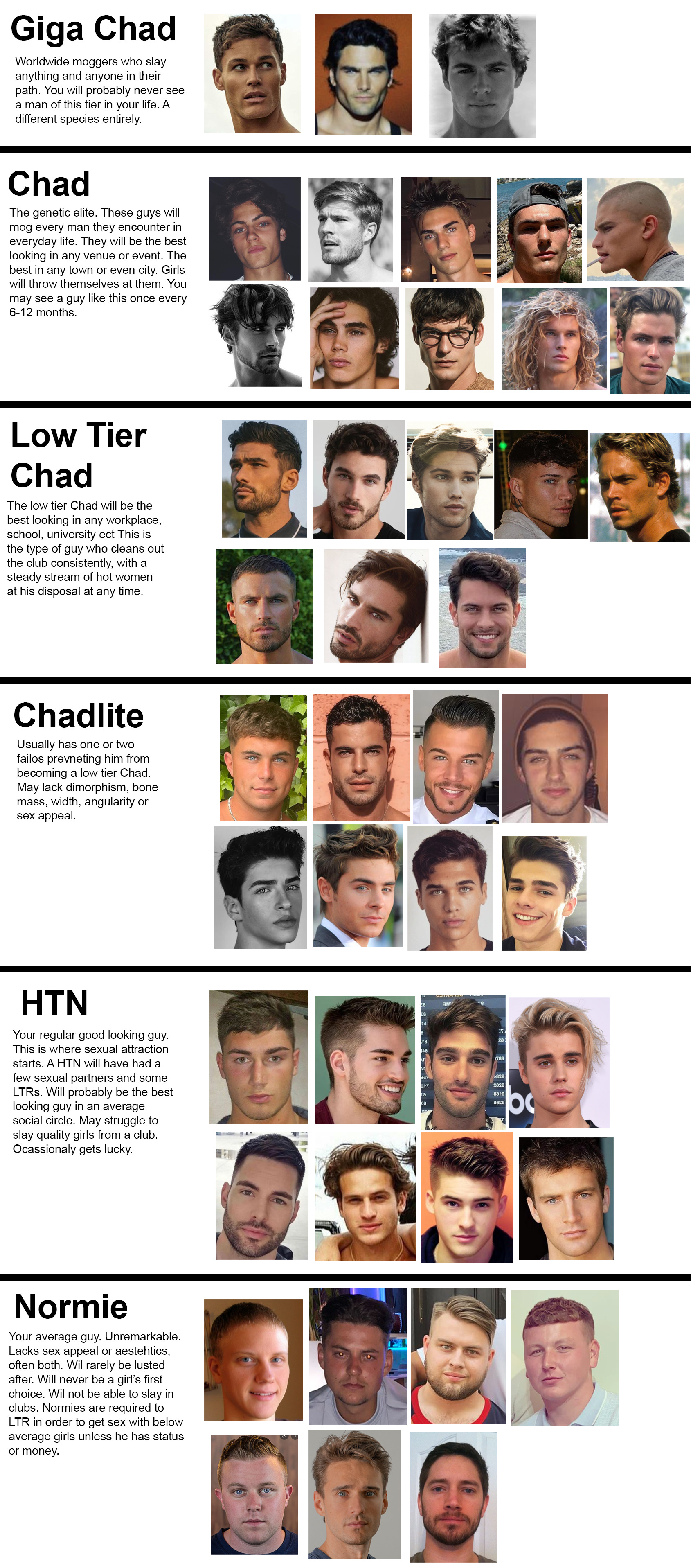
But I don’t think straight men are borrowing from gay men. I think gay culture got there first because it was already operating on different rules from the mostly reproductively-oriented heterosexual world. Centuries underground, no default script for family formation, no reproductive telos baked into the relationship structure, no real institutional scaffolding until very recently. Gay men — particularly gay men in the United States — were the first men who had to operate as pure individuals on the sexual market, evaluated by other men, optimizing for other men’s standards. The body dysmorphia, the chemical escalation, the frictionless ranking systems: these are what happen when male sexuality encounters itself with no mediating structure.
What contemporary life — the Sexual Revolution4, capitalism, the Internet — has done is extend those conditions not only to straight men, but to everyone. The PSL forums and rating threads put them in the same position: evaluated by other men, according to male standards. In gay hookup culture, the optimization cycle has a clear sexual outlet. In straight looksmaxxing, what you get is nominally heterosexual men reproducing the non-reproductive logic of a culture that was never oriented toward reproduction in the first place, not because they copied it, but because they arrived at the same conditions under different circumstances.
As I wrote last year, looksmaxxing is what our society already encourages: endless self-optimization toward nothing, a life of becoming. The Human Potential Movement promised that everyone could be more. What we live with now is the hangover, the conviction that we must be. What looksmaxxing offers is potential itself as a terminal condition, becoming that never arrives, a body always in progress and never in use. In gay culture, the circuit party eventually ends. In straight looksmaxxing, you just die, I guess?
THE LOOKSMAXXERS WHO FAIL
The most alarming frontier of looksmaxxing is the people who fail — that’s actually how I first encountered Clavicular, an account that tracked such cases.
DIY cosmetic modification (including HRT and biohacking) has been widespread, so it’s possible that the whole looksmaxxing thing is unremarkable in that way. But still, I think it’s well-worth remembering that for every person who can afford to get work done professionally, there are dozens more doing it at home. The at-home fillers community skews toward women motivated by cost. The black-market butt injection scene, which has killed people for decades, draws heavily from Black and Latina women priced out of legitimate surgery. Practitioners in these cases have injected patients with cement, tire sealant, bathroom caulk, hardware-store silicone. The through line is always the same: people who can’t afford the professional version doing it themselves.
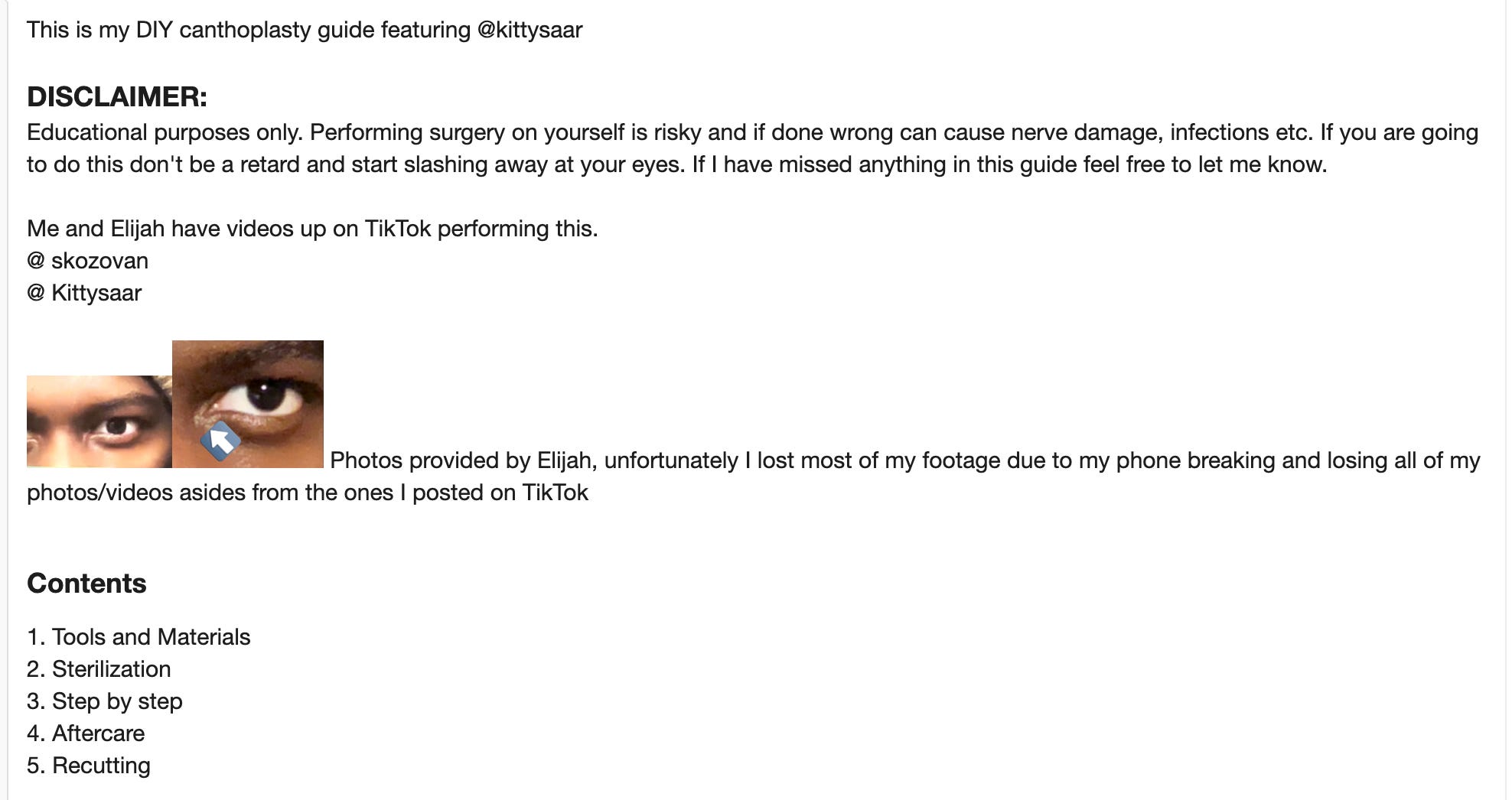
On looksmaxxing forums, the horror is more methodical, though. It’s not that injecting tire sealant into your ass isn’t grotesque, but the attention to detail from looksmaxxers somehow increases the body horror quotient. Take this detailed guide for DIY canthoplasty, self-performed eye surgery using a snapped razor blade:
Or the fixation on the jaw:
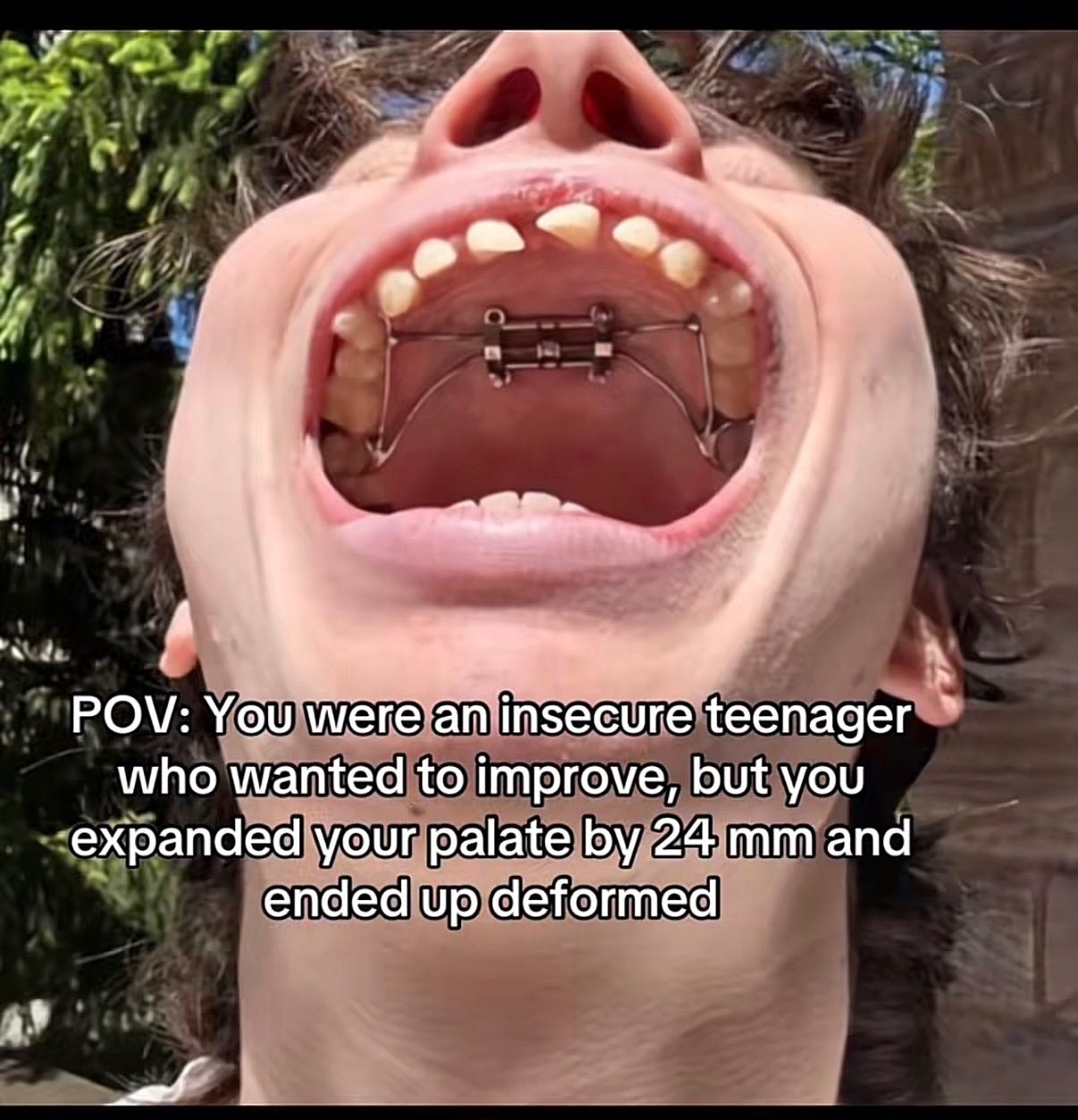
If I wasn’t such a coward, I gotta be real, this would be me. I want DJS, too, goddammit!
INDIAN LOOKSMAXXERS
I stumbled across this interesting piece about Indian looksmaxxing in The Juggernaut. Unfortunately, it’s paywalled, so I haven’t had the opportunity to read it yet. But it’s not a surprise that Indian men are invested in this community, especially after seeing how Indian-American men talk about themselves.
When I was writing about transracialism last year, I kept seeing posts by South Asian men in private Facebook groups and on Reddit who were trying to “racemaxx.”
Racemaxxing has two conflicting definitions. One means leaning into the race you were born into as an attractiveness strategy, basically playing to type. In practice, this advice is most often given to Black men: lean into what’s already culturally coded as attractive, work with the hand you were dealt, lean into the stereotypes.
The other definition reverses that completely, and is usually the prescription for South Asian men: skin bleaching, colored contacts, legal name changes to hide background, lying about ethnicity on dating profiles, even getting iris implant surgery to change eye color, a procedure that often ends in blindness. The first version says optimize what you are. The second says what you are is the deficit. The desire to be more attractive shades into the desire to be a different person, which shades into the desire to belong to a different race.
I’m curious how this dynamic plays out in India — my guess is, unfortunately, with no fewer skin-lightening products.

Stanisław Przybyszewski excluded, of course
Arguably, many pundits on the right adopted anonymity because of the ruthlessness of anti-fascist initiatives which didn’t only seek to dox but actively harm people they believed were fascist-aligned. Sometimes, these attacks targeted people who explicitly self-identified as Nazis, racists, etc. Other times, it happened to people who socialized in the wrong online subcultures or were “guilty by association.”
… particularly from a position where your own income doesn’t depend on the economy you’re critiquing.
I’m a strong believer that PUA culture is downstream of the Sexual Revolution
Born into the wrong race? Born in the wrong body? How about those of us who think we just might have been born - "on the wrong planet?" Or am I just 1 of 1? : /
I stopped reading at razorblade, and still, JFC.