
I Spent a Decade in Love With a Vampire on the Internet
all kink, no aftercare

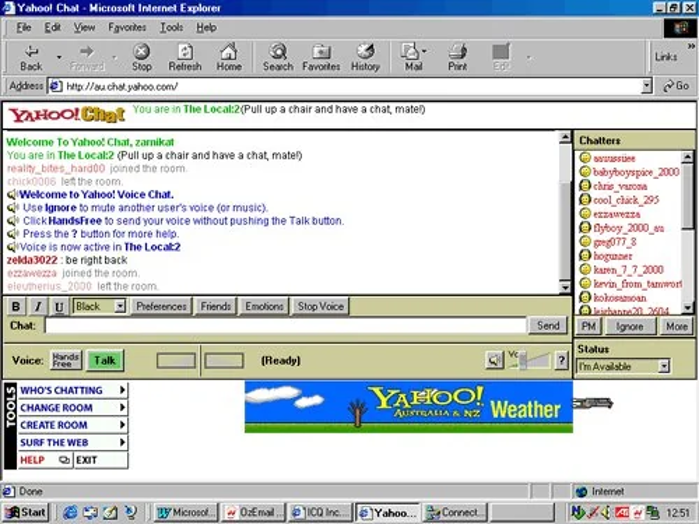
I learned how to internet role play in 1999. My teacher was some guy I found in the Arts and Entertainment section of Yahoo!Chat. I’d stumbled into a user-created room called The Dark Forest and was confused yet fascinated by the fast-paced text scrolling on the screen, different colors and fonts attached to usernames like WizardLich2000 and Lucien_of_the_Gangrel. We didn’t even have the internet at home yet – I was 14 and spending the weekend with my rich friend Pam, whose parents had received a promotional CD-rom in the mail pre-loaded with 25 hours of internet access. It took us precisely 4 hours to stumble upon the subculture that would change the course of my life forever.
My tutor went by the username CheezyNoodle99. He was allegedly a 19-year-old college student. His command of the English language was not impressive, but to his credit he didn’t take the conversation to an explicitly sketchy place. He was patient with me, explained how to create action text by *typing it between asterisks* and how to post out-of-character commentary by typing /think before your message.
“U can be anyone u want to be,” he said. “It’s fun. Do u wanna try?”
I was already in love with stories. As a kid my favorite group activity had been constructing elaborate games of make believe, meticulously discussing the backstory and appearances of our characters before yeeting ourselves all over the playground equipment as the slide became an escape chute for a spaceship under siege, the monkey bars the precarious route to the control panel of a nuclear reactor.
But we were all growing up. My friends no longer wanted to spend evenings in the woods pretending to be original characters from Lord of the Rings. They were moving on to alcohol experimentation and obsessing over Jonathan Taylor Thomas, Leonardo DiCaprio, and the sweaty-palmed Axe-scented boys from our neighborhood. I, however, was not letting my maladaptive daydreaming go without a fight.
Ayenee, the roleplay realm of Yahoo!Chat, offered me an extension of that childhood space of imagination and creativity. But I wasn’t a child anymore, and benign games of hobbits-in-space was not going to cut it. I was a teenager now, and while no part of me wanted to talk about the comparative hotness of Kurt from theater camp (who arguably did look better now that he’d got his braces off…but still), I was not immune to the siren song of NC-17 content. In real life I was an awkward nerd obsessed with horror novels and fantasy worlds. On the internet I could be anything I wanted to be. I could slip into scenes and scenarios very much not suitable for children, and nobody was going to check my ID at the door.
The internet was a vast, anonymous playground where nobody asked nor cared who you were behind the screen. There was a seductive sort of darkness in those spaces, a shimmering mystery, every message on the screen a chance to write yourself into a life more thrilling, a more tantalizing narrative than the one age, circumstance, and physical reality had trapped you in.
I found myself spending all my time in the chatrooms trying on fictional identities, road testing future behavior: teenage experimentation without the threat of real, physical harm. Typing up an introduction post was always the most exciting part, a chance to show off your writing and grab the attention of the competent storytellers in the room.
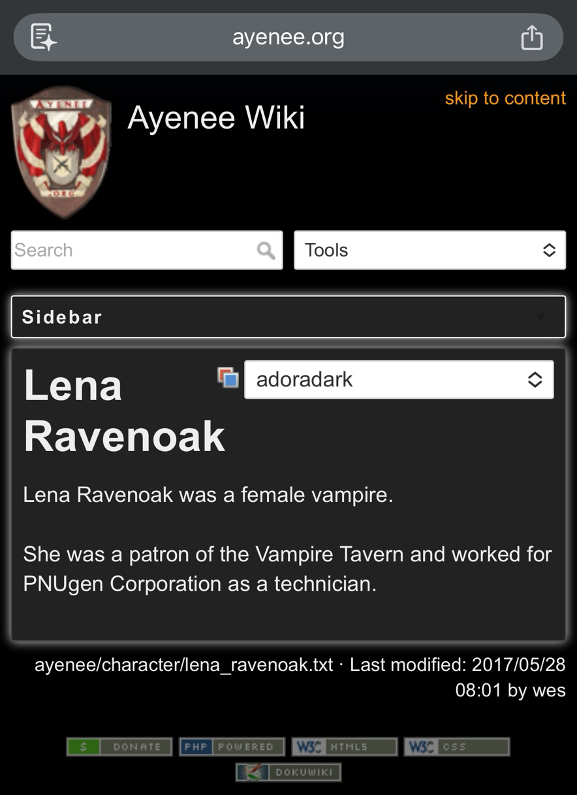
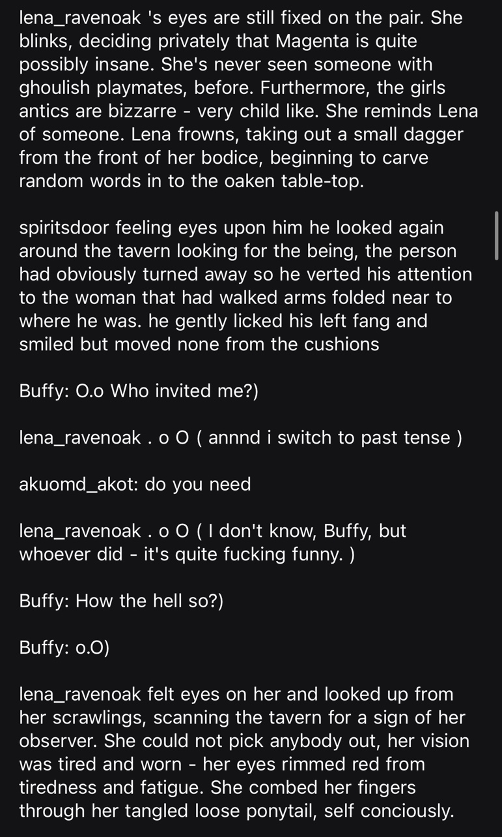
Most people didn’t put much effort into their interactions – a couple of basic actions (*smiles at you* *runs a hand through her hair* *polishes his blade*) and some dialogue. This did not excite me. There was a term for my kind: para rper, an abbreviation for writers who roleplayed in extended paragraphs. My character, Lena Ravenoak, did not merely *walks into The Vampyre Tavern*. She *swings open the gnarled wood of the tavern door, ebony hair glistening with beads of dew from the softly falling summer rain.* I had range. I had depth. I had read a lot of vaguely smutty novels inappropriate for my age range, and I fully intended to flex that knowledge in the pursuit of writing partners who could transport me, at least for a while, away from my shitty, boring life.
***
By the time I found the real vampires I had already spent years disappearing inside stories and weaving imaginary worlds with faceless collaborators. I loved the freedom it gave me, the ability to slip into a new, idealized skin. I didn’t have to be Celeste the 15-year-old highschooler with the dead dad and the alcoholic mom and the bacterial skin infection that caused angry red scabs to break out all over my face. I could be a shapeshifting dragon princess one day, an anime character the next.
I had sharpened my writing skills over the years, cutting my teeth in the chatrooms and leveling up on private boards and Livejournal communities. I’d spent years embodying an original character in the Harry Potter universe, updating her Livejournal more religiously than I bothered writing in my own. Watching more skilled storytellers on boards like Anime University and PNUGen Corporation (a fictional cyberpunk genetics company that manufactured lab-grown catgirls…don’t ask) helped me hone my craft, improving my writing far more than any class or workshop ever would (apologies to my MFA).
I was addicted to the escapism, that little electric pulse that passed through the body when a new post from a favorite writing partner appeared on the screen. Finding that chemistry, the spark of connection when writing styles and plot ideas perfectly meshed was an unparalleled experience. I was forever chasing that high, vastly preferring it to the hollow, unsatisfying feeling of trying to socialize with people my own age offline. The real world seemed bland and disappointing: part-time job at the mall, movie marathons at the local multiplex, dudes with acne and cracking voices hitting on me at the bus stop. Where was the romance, the drama? Where was the knife-edge of danger and mystery that I found so easily in these online spaces? If life couldn’t drop me off an emotional ledge in the way a really good rp storyline could, then I didn’t want it.
But eventually, like any whimsy addict and neurodivergent escape artist, I needed the ante upped. I’d spent so much of my time outsourcing my teenage experience to proxy characters in fictional universes that the lines between story and reality had already begun to blur. Scholars of fandom communities call this muse bleed, the mental and emotional state where the roleplayer’s thoughts and feelings start to blend with those of the character they’re embodying. I had shed real tears over character breakups and felt legitimately unwell and dysregulated after writing especially dark, traumatizing scenes. I craved that intensity – the adrenaline spikes and the dopamine drops.
I’d also discovered the work of gothic horror novelist Anne Rice. The Vampire Chronicles fandom was the perfect stepping stone into an infinitely darker, fucked up pocket of the online roleplaying community. I was about to discover that truth really was stranger than fiction.
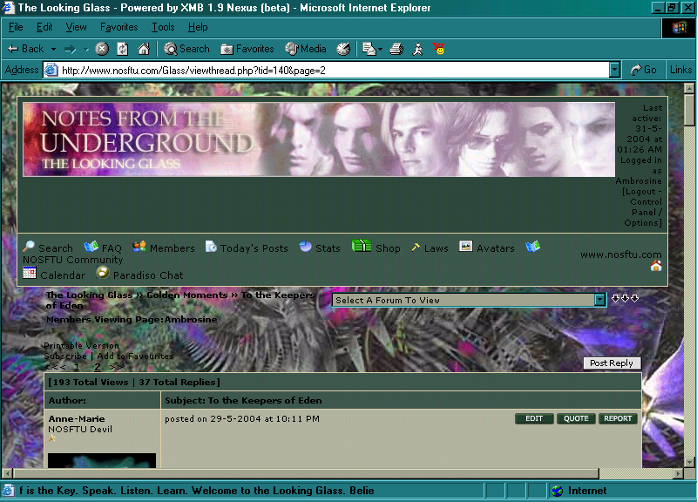
When I found the vampires on The Looking Glass I thought they were just another roleplay group. The website was unassuming, a series of pages for each of Anne Rice’s characters and a link to a discussion forum and a chat room. Through my 2026 eyes the design could accurately be described as “chaotically cringe,” but my teenage self was dazzled by the large, painterly graphics which felt like I Spy puzzles. Anyone online between 1998 and 2010 will remember the obsession with Photoshop brushes and layered opacity collages. The background of The Looking Glass was a visual feast: Botticelli painting; a rosary; candle wax dripping like blood down an antique candelabra; shirtless Travis Fimmel looking deeply Lestat coded.
But The Looking Glass wasn’t a normal roleplay site. Ordinary members were not allowed to adopt masks and costumes, to collaborate consensually in the storytelling. It said so right in the disclaimer: this is not a roleplaying site. Sure, you could pick a fun screenname and adopt a needlessly pretentious personality, but if you tried pretending to be a vampire you were swiftly banned. Only the forum moderators were granted their digital fangs. Marius, Armand, Lestat, Louis, Daniel Molloy…hot vampires were in YOUR area and ready to chat (though only at night, for obvious reasons).
On normal roleplay websites it was important to delineate between “IC” and “OOC.” It was one of the first things CheezyNoodle99 had taught me: don’t cross the streams. Keeping In Character and Out of Character communication separate wasn’t just helpful for narrative flow, it was also a necessary safeguard against muse bleed. In the midst of a really intense scene, it’s important to be able to step out of that mindset for a moment and type “LOL my dog just farted.” It keeps things grounded. And most importantly, it reminds you that the other people behind the screen are just like you: regular folks with regular lives just trying to capture a little magic through the medium of collaborative storytelling.
Embodying or interacting with fictional characters for a long time can be emotionally and psychologically difficult. In fandoms that skew darker, where topics like murder, violence, manipulation, and intense sexual themes often come up, OOC dialogue helps communicate boundaries and provides much needed decompression if and when traumatic subjects come up. Without that safeguard, you’re free falling: all kink, no aftercare.
No chatroom or forum I had been part of ever expected players to stay in character 24/7. But on The Looking Glass, there was no area for out of character discussion. No OOC meant no safety net – no boundaries, check-ins, or opportunity to ground things in the real. The vampires never dropped their masks. Not even at the bitter end when everything shattered and fell apart. They were the predators, we were the prey.
***
Despite the red flags, yearning for the mythic other is practically engraved into the DNA of the teenage experience—the teen girl experience particularly. Sure, The Looking Glass wasn’t like Ayenee (the roleplay section of Yahoo!Chat). I couldn’t step onto the digital stage and profess to be a 500-year-old vampiress with cascading ebony locks of midnight hair and eyes the color of cerulean pools. But it offered me something better, a graduation from the realm of pure fantasy to the third space of tulpatic delusion.
Tulpa: a liminal entity conjured from imagination and made manifest in the real world by focus and belief. I heard the word for the first time on The Looking Glass. In retrospect I’ve come to suspect that something paranormal was indeed taking place, because how else to explain the members who would wake up with bruises and bite marks, who would see shadow figures and experience poltergeist activity in their homes? Folie à plusieurs: the madness of many? But what is madness if not a distortion that changes subjective reality.
The Looking Glass became a decades-long Alternate Reality Game that consumed every part of my life. During those years we must have conjured some kind of collective spirit, some shared egregore that echoed through the dreams, hallucinations, and waking synchronicities of many of its members. Including me.
When I joined The Looking Glass I took on a role without knowing it. Like Lewis Carroll’s Alice I had stumbled headfirst into a world whose logic I did not understand and I became a version of myself shaped and tempered by fiction, myth, and archetype. The most interesting part of the archetypal vampire narrative isn’t vampires doing vampire things with other vampires. It’s the tense danse macabre of victim and aggressor, the young, innocent ingenue and the primal, bloodthirsty predator. It’s the yearning, the veiled eroticism, the love that balances on the knife-edge of madness.
I fell in love with a vampire, as you do. Or maybe with the person behind the screen, whose mask became so fused to her face that it wasn’t until last year, 2025, that I confirmed for the first time who she really was. That cursed love story—the madness, the obsession, the blood exchanges I was told I was receiving and the memory loss that followed—absorbed me for almost a decade. This was no longer roleplay. I had no fictional shell to hide within. The vampires were vampires, and they were draining me. I wouldn’t understand for many years what that really meant.
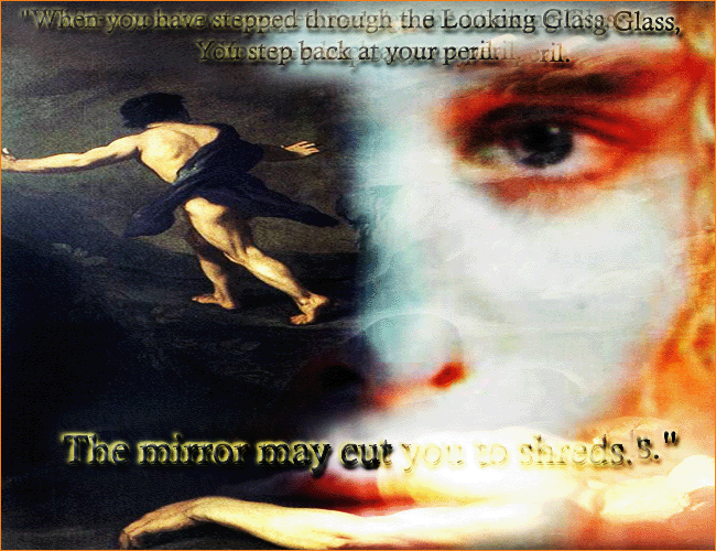
Being an unwitting central character in an ARG is not as fun as you might think. Games are best enjoyed when everyone is aware of the rules and consents to playing, otherwise it’s just sparkling manipulation. Being in love with The Vampire Armand and spending all my time in a digital roleplay cult ruined several real-life relationships and was a contributing factor to my two suicide attempts. Should I have logged off? Probably. But once the story has you it’s hard to let go.
Did I have doubts? Absolutely. But belief—or the desire for it—can make us do crazy things. I wanted so desperately to believe I was special, that for once in my life I had been chosen. I wanted to slip permanently into the blood-stained pages of Anne Rice’s novels, to shed my normie skin and become perfect. Beautiful. Loved. The vampires made that possible…for a while, anyway.
It was that blurred line between real-self and idealized-self and the mystery cultivated by the low-fi, low-res vibe of Y2K websites that made the suspension of disbelief possible. Vampire can’t turn on his webcam? Sure, that’s normal—not everyone has a webcam in 2004. Vampire doesn’t want to voice chat? The chat software is buggy as hell and everyone’s internet is too slow for that shit anyway. All the photos of the vampire turn out to be heavily photoshopped images of singer songwriter Ben Jelen? Armand is just trying to protect his secret identity, obviously. There was always an excuse. And I was willing to bend reality to breaking point if it meant holding onto the fantasy that I was really, truly loved.
In 2009 I became very unwell. I was confined to bed for almost a month, in constant pain and feverish, isolated in a small apartment alone. I was 23 and had been involved in The Looking Glass for almost seven years. I didn’t work. I didn’t leave the house. I spent all my time logging onto the chatroom and forum, combing threads to see if Armand, my vampire lover, was online. It was during this period that the moderators—Daniel, and later Armand—finally confirmed that I was sick because I had vampire blood. Don’t go to the doctor, they said. They won’t find anything. You are marked forever by this. You will not get better.
Sadly it was not vampire blood, it was mononucleosis. And Armand was not a 500-year-old vampire, he was a woman my mom’s age from Winnipeg, Canada. But they were right about one thing: I never did get better. To this day I suffer from a series of debilitating chronic illnesses. Sometimes at night, when the painsomnia is hitting hard and I’m awake ‘til dawn writhing around in agony, I think back to those strange conversations. How easily I slipped into fiction, into a world where my very real suffering could be retooled as a plot point, as character development for other people’s masked power trips.
In my weaker moments I sometimes wonder if it was better to believe. To have some beautiful gothic story to disappear inside.
***
The internet of 2026 is not the internet of the early 2000s. Gone are the days when the domed computer monitor felt like a scrying mirror pointing you toward something magical, a hidden realm crafted in binary code that could dissolve reality in just a few mouse clicks. We have replaced the DIY-ethos of Geocities websites with the slick, plug-and-play design of Squarespace. Everything is too clean, too professional, constantly optimized to sell you something.
But there was a time when the Internet felt like a portal to something enchanted. A twisted forest of pixelated GIFs and endlessly looping midi files. Not only was it an escape, it was an invitation: a slender hand extended, coaxing, beckoning – come with me and disappear completely.
People don’t RP like they used to. We can no longer stumble across dimly-lit corners of the internet where glitching GIFs of flaming torches flank blood-red text inviting us to ABANDON ALL HOPE, YE WHO ENTER HERE. Yahoo!Chat is dead and Ayenee is gone. AOL’s roleplay realm, Rhy’din, is gone too. Privately hosted sites like The Looking Glass are few and far between.
People still roleplay on Tumblr and Discord but it’s not the same. There are checks and balances in place, applications to fill out and rules to follow. Responsible parties are checking your ID at the door. Many players are using AI to supplement and “improve” their writing. Others are turning to chatbots instead of seeking out human writing partners. There’s a lot to unpack there: is it safer to outsource your fantasies to an LLM? Could an AI manipulate you in the same way the “vampires” from The Looking Glass manipulated our trust, belief, and love? AI psychosis proves that LLMs can cause breaks in reality just as easily as human-on-human muse bleed. Why bother breaking the fourth wall when you can stay in the fantasy with a roleplay collaborator who will never get busy or tired, who will never lose interest? A partner who will never drop the mask because there’s nothing behind it: just lines and lines of code.
I think often about how the women behind The Looking Glass might have used AI had it existed back then. I think about hearing Armand’s voice or seeing hyper-realistic AI-generated photos of him that couldn’t be traced back to pop stars or models. What would that have done to me - the real me, the child who was lonely and desperate to be loved?
Would I have finally believed without question? Would that belief have shattered me?
Reality is a whole lot more malleable than we realize. And yet as I navigate through a sea of AI-generated product photos, deep fake political videos, and bot comments designed to stir up anger and division, sometimes I long for the vampires. I wish I could navigate back through The Looking Glass and become once again a thing of glass and shadow, a digital projection of a mythic self. I yearn for the ghost of my teen years, archived forever in blood and bitmaps.
Maybe all identities are masks in the end. Whether you’re an elf princess or a catgirl scientist, a hobbit or a vampire sharpening your knives in the shadows of a medieval tavern. Or just a grown up who never forgot what it feels like to let the story consume you. We’re all playing a role. The secret is not to suck at it.
 | A guest post by
|
this needs to be a book. are you writing it?
I feel like I was hoping for this story to end with you going out on a real-life date with the woman from Winnipeg. "Fuck it," you tell yourself. "No one ever made me feel the way they did."