

We Thought the Internet Was For Us. It Turns Out It's For AI.
how AI is liberating intelligence from humans

We thought new media advance social development through transformations. But, as in an old joke, it may be asthma mistaken for orgasm. In reality, the millennia-long chain of media transformations might reflect the technological imperative, an emergent force that drives media evolution and refines intelligence from biology. A chapter from Andrey Mir’s new book, The Technological Imperative: Why We Develop Our Media. Essays on Human Agency and AI, presented for default.blog
THE EXPLOSION OF AUTHORSHIP
How many authors did humankind have before the internet?
By authors, I do not mean talent or charisma, those are hard to gauge, but a simple technical parameter: the ability to reach beyond one’s physical surroundings with one’s own ideas and opinions. That is what technically makes you an author: you must externalize your ideas, most often in text, and use media to deliver them to others where you cannot reach people personally. (Clay Shirky: “Media is how you know about anything more than ten yards away.”1)
Curiously, we can calculate, with enough precision to observe a pattern, how many authors humankind had before the internet. In 2010, the Google Books project2, aimed at digitizing all books ever written, counted 129,864,880 books produced by humankind in all of history.
According to other estimates, scientists have published about 50 million articles in academic journals since the late 17th century.3Some authors wrote many texts, some texts were coauthored, but that is irrelevant, as we are looking for an order of magnitude. We can add about one million journalists, as well as politicians, marketers, academics, and others who have conveyed their ideas beyond their physical reach. We find that the estimated number of authors over five thousand years of human history, from the invention of writing to the internet, hardly exceeded 300 million, and that is a rather generous estimate.
Suddenly, thanks to the internet, the number of authors reached 6 billion, 74% of the global population.
Suddenly, thanks to the internet, the number of authors reached 6 billion, 74% of the global population.
Of course, there are many caveats. Not everyone who is digitally connected uses it to reach strangers. Digital authorship is very diverse, ranging from heavy to lazy authors.4 Some sources suggest a Pareto 80/20 distribution, meaning 20% of users produce 80% of the content.5 There is also the often-cited “1-9-90” rule: 1% create original content, 9% comment, and 90% are lurkers.6
But I extend this technical authorship to all who have digital access. Even when lurkers like and share, they contribute their personal choice to content distribution. The system is designed to extract personal activity by all means, often automatically elevating it to “technical authorship.”
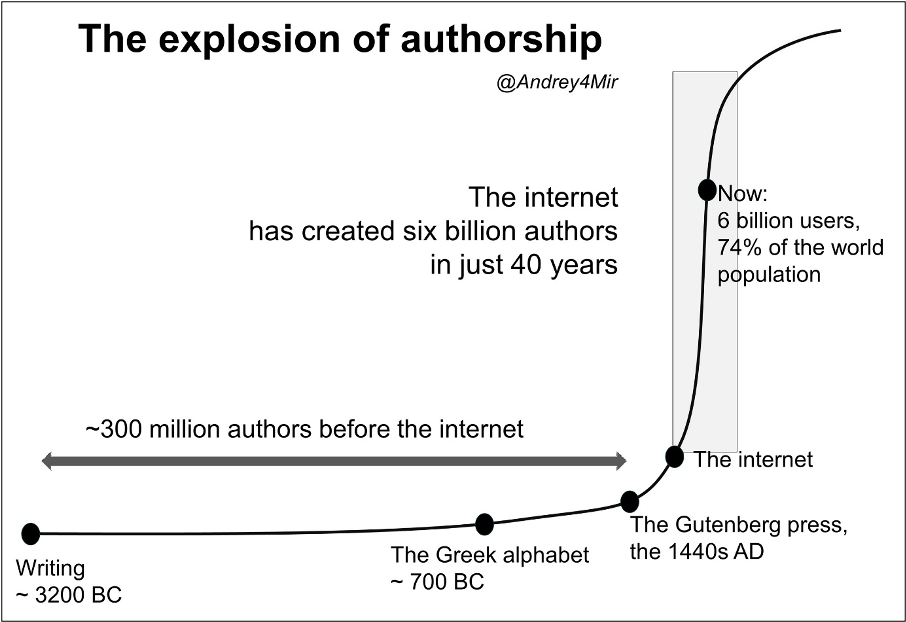
Over five thousand years, humankind accumulated about 300 million authors. Now, in a mere 40 years of the internet, the number has doubled if we count only heavy authors, or increased by orders of magnitude if we include all those who are digitally connected. We live in the midst of an unprecedented explosion of authorship that may explain many of the disturbances we have experienced over the past couple of decades.
THE EMANCIPATION OF INFORMATION: FROM ANCIENT EGYPT TO CHATGPT
The emancipation of authorship belongs to a sequence of similar historical processes in which new media emancipated the circulation of information.
1) THE EMANCIPATION OF WRITING: THE ALPHABET
The first emancipation of content was the emancipation of writing. It unfolded over millennia. Hieratic and later demotic script in Ancient Egypt, the commercial use of cuneiform in Sumer with increasingly phonetic components, and finally the emergence of the alphabet in Phoenicia and Greece all helped emancipate writing from temples and make it available for public and private use, for scientific exploration, and even for self-expression.
As a result, palaces and temples lost their “monopoly of knowledge,” as Harold Innis called it.7 In the aftermath, new civilizations emerged, each armed with a phonetic script: Greece captured minds, and Rome captured lands.
2) THE EMANCIPATION OF READING: PRINTING
The second emancipation of content followed the invention of the printing press by Johannes Gutenberg around 1445. This was the emancipation of reading. Then came the Reformation, religious wars, and political revolutions. Palaces and temples once again lost their monopoly, this time over the interpretation of content. As a result of Gutenberg’s invention, monarchs were beheaded, world maps were redrawn, vaccination and electricity were discovered, and man went into space. Modern society was born.
3) THE EMANCIPATION OF AUTHORSHIP: THE INTERNET, THE BLOGOSPHERE, AND SOCIAL MEDIA
The internet gave people control over their attention. Unlike TV viewers, internet users gained full freedom to browse content beyond a narrow set of elite-controlled channels. This alone undermined the established order and caused the “crisis of authority,” in the words of Martin Gurri, who described this process in his famous The Revolt of the Public.
The blogosphere, and later social media, gave users access not only to unsanctioned information but also to unsanctioned self-expression. People began to shape alternative agendas, bypassing mainstream media. As they saw how many of them there were and how underrepresented they were, they recognized their demands and their power and turned to protest. First, these were the Twitter revolutions of the early 2010s, from Mubarak’s Egypt to Obama’s America and Putin’s Russia. Then the second demographic wave of the same process arrived in the mid-2010s, resulting in a conservative backlash from Brexit and Trump to AfD and Marine Le Pen.
4) THE EMANCIPATION OF INTELLIGENCE: AI
The latest information emancipation has just started, and this is something we still need to grok. But it clearly follows a pattern of media emancipation: a new medium liberates certain aspects of how information is produced, distributed, and consumed, each time reshaping society.
This time, it is the emancipation of intelligence. But emancipation from what? It somewhat resembles the development of phonetic writing. Just as the alphabet emancipated writing from the pictorial semblance of physical reality, artificial intelligence emancipates intelligence from the constraints of its biological carrier—humans.
It is worth noting how the acceleration of historical time is at play here, shaping the pace and the scale of transformations. The emancipation of writing stretched over nearly two millennia, while the emancipation of reading lasted two to three centuries. The third emancipation of content, the emancipation of authorship by the internet, took only forty years. The latest emancipation of information, the emancipation of AI, started with ChatGPT just three years ago, and we are already approaching the same magnitude of consequences as previous media emancipations.
WHAT IS THE EVOLUTIONARY MEANING OF ALL OF IT?
When I first described the emancipation of authorship in 2014, in the aftermath of the Twitter revolutions, I thought the evolutionary meaning of all those media emancipations (including writing and reading) was social realignment caused by the emergence of new media.
But it was not. The evolutionary meaning of the internet seemed to be
1) the transfer of all human knowledge and all human speech into the digital, where they became available to future AI, and
2) the rise of the high-tech industry capable of creating AI. Media evolution needs our digital activity for AI to learn from us, just as a meadow needs the activity of bees, so it has made digital platforms engineer our engagement.
As in an old joke, we thought it was orgasm, but it was asthma. We thought the development of digital technologies advanced humankind through social realignment, but it was the technological imperative funneling human efforts and resources into artificial intelligence. The internet is the space where AI consumes all human knowledge and all human speech. The benefits humans receive from the internet serve to attract human activity, just as the nectar that bees collect from a flower serves to attract them for pollination. As Marshall McLuhan once said, humans are “the sex organs of the machine world, as the bee of the plant world.”
Aside from the alleged nectar of engagement, all we got from it was asthma indeed—all the social cataclysms invariably accompanying each stage of hatching a new form of intelligence out of the biological species of humans.
SOCIAL FALLOUT: THE COLLAPSE OF THE REAL INTO THE DIGITAL
What, then, is the asthma, the social cataclysm of this latest media emancipation—the emancipation of artificial intelligence? The symptoms are many, yet all fall under a single canopy: the collapse of reality. As technology drives us to transcend biology, it also severs us from the physical world.
The farther we progress with generative AI, the more content is produced by AI. In the first iterations, it reused content produced by humans. But as time passes, given the speed and volume of content generation, AI inevitably cannibalizes its own previous outputs, already aimed not at reflecting reality but at grabbing attention: AI slop.
AI slop begins as a contaminant of human content, but through repeated self-recycling it progressively purges human residue and distills into a self-referential product whose sole purpose is attracting bees’ activity, not reflecting the meadow.
Multiply reused AI slop does not even presuppose the real, as Baudrillard’s simulacrum, the product of electronic media, still did. There is no longer anything to simulate. In AI slop, denotative reference to things in physical reality dissolves completely.
We have shared our language with AI to make it learn cognitive structures, which makes sense. As a result, we and AI share a common language in which AI has no grounded references to reality and cannot have them. Over time, the AI-generated share of that shared language overgrows or even overrides our referential needs. At what point is it no longer symbiotic but already parasitic?
At some point, AI-generated content is no longer the contamination of human content by AI slop—it is rather the multiple distillation of AI slop, which removes residual human inclusions and refines a pure artifact of its own.
AI AND AGENCY
The “epistemic partnership” of humans and AI, to use Paolo Granata’s term8,creates an ecosystem in which human authorship may still matter on the side of production but matters much less on the side of consumption.
Humans still have many heavy authors who create original content—likely more than in all of human history. But everything created by humans will be refurbished, at an accelerated pace and likely many times, into AI slop. Eventually, the share of original human-made content will decrease to an indistinguishable degree.
One would hope that human creation would turn into a demand-driven value due to its rarity amid the abundance of AI slop. True, people claim that they will always prefer human-made content over AI-generated content. But this may be the so-called social desirability bias—proper answers to surveys, conflicting with real behavior. Considering the availability and overabundance of AI slop, especially as its quality improves, it will be extremely hard for users to reject AI-generated content in favor of human-made content when it’s already before your eyes in the feed. At some point, choosing human over AI will involve too much friction, which does not suit the nature of frictionless digital consumption. Withdrawing from frictionless digital consumption is as hard as refusing to take soma in Huxley’s Brave New World; only iron-willed dissidents can do that.
But most importantly, we need to measure the alleged demand for human content not against AI content, of which it will comprise a tiny fraction, but against the capacity of people to consume it all. We have about 16–18 hours per day for media consumption, and all available time has already been taken. The fight for time in the daily media diet will continue, but guess who will be winning at scale—humans or AI?
Finally, human prompts can soon be bypassed altogether. Agentic AI has approached the level of self-tasking. It is already possible for AI agents to have various forms of online access and to proactively post content they generate themselves, which will make it indistinguishable from the output of human agents.
Of course, we can always say that they do not have a rich inner life. But that does not seem to prevent anybody, including humans themselves, from displaying activity that looks like agency.
Paradoxically, the only form of communication that preserves referentiality and “reality-check” is coding. Code still has real feedback, which consists of its applicability. Code is tested by whether it runs: if it does not perform, it is rejected. This creates immediate, objective feedback—an objective reality for code. Digital is “empirical” for coding.
The evolutionary meaning of human content remains to keep people engaged, with all our resources and labor offered to AI. But the technological imperative seems to have found a new medium to seek perfection in its performance and develop, perhaps, into some new form of AI self-communication.
Shirky, Clay. (2010). Cognitive Surplus: Creativity and Generosity in a Connected Age. P. 54.
Taycher, Leonid. (2010, August 5). “Books of the world, stand up and be counted! All 129,864,880 of you.” Google Book Search Blog.
Jinha, Arif E. (2010). “Article 50 million: An estimate of the number of scholarly articles in existence.” Learned Publishing. 23 (3): 258–263.
See the chapter “Social media emancipated authors, but to what end? Platform capitalism is the hunt for ‘lazy authors’” in: Mir, Andrey. (2024). The Viral Inquisitor and other essays on postjournalism and media ecology.
Matei, Sorin Adam, and Bruno, Robert J. (2015). “Pareto’s 80/20 law and social differentiation: A social entropy perspective.” Public Relations Review, Volume 41, Issue 2, June 2015, pp. 178–186.
Nielsen, Jakob. (2006, October 8). “The 90-9-1 rule for participation inequality in social media and online communities.” Nielsen Norman Group. See also Wikipedia: 1% rule.
Innis, Harold. (1950). Empire and Communication.
Granata, Paolo. (2025). Generative Knowledge: Think, Learn, Create with AI.
 | A guest post by
|
No facet of this current schizophrenic fever dream over “AI” is more obvious to me than the systematic overrating of intelligence’s power in the world. The entire history of humanity is an object lesson in the limits of intelligence, in its ultimate powerlessness.
Interesting article.
One point occurred to me towards the end - AI coding tasks often have ‘instant feedback’ as you say (whether or not the system works as intended). But sometimes the intrusion of objective reality is deferred - I.e. the problem many programmers have with AI is not that it tends to produce broken code, but that it produces code which is less scalable, secure, sensical down the line.
So people are engineering their own feedback loops to provide a the kind of objective checks you describe (how objective are they really then at this point?)
I think the picture is equally murky - quasi-objective measures of
success could also be established for written tasks, for instance how well it captures attention. E.g. a AI-powered Substack account could learn from the performance of its various articles.
Great piece, thanks for sharing