

Understanding Celeste Rivas Hernandez’s Murder Through the Lens of the Wendigo
the hidden threat of gore videos

Celeste Rivas Hernandez was 14 when prosecutors say she was killed in April 2025. On September 8th, one day after what would have been her 15th birthday, her decomposing remains were found in the front trunk of a Tesla in an L.A. tow yard. The L.A. County medical examiner ruled her death a homicide.
The suspect was the Tesla’s owner, the musician David Anthony Burke, better known by his stage name d4vd, who prosecutors say had been sexually abusing1 Celeste since she was 13. In April of this year, prosecutors charged Burke with murder, continuous sexual abuse of a child under 14, and unlawful mutilation of human remains. D4vd pleaded not guilty. Hearings began this month to determine whether there’s sufficient evidence to put him on trial.
I first heard about this case on Reddit, while doing research for a piece about the occult and LLMs. In a now-deleted post on a subreddit for fans of the musician — which, regretfully, I didn’t think to screenshot — a young person had claimed to have spoken to Celeste Rivas’s “ghost” via ChatGPT, using the LLM as a sort of digital Ouija board.
Curious about what this was about, I started clicking around. I learned that Burke, similar to a string of recent mass shooters, had claimed in a Discord server, where he allegedly connected with underage fans, that he was “addicted” to gore videos, real footage of people dying; that Discord was Burke’s hunting ground; and, perhaps creepiest of all, that his fans believed that he hid Easter eggs about his homicidal desires throughout his song lyrics and music videos, like this one, in the not particularly subtly titled “Romantic Homicide”:
I’m scared (ooh-ooh-ooh)
It feels like you don’t care (ooh-ooh)
Enlighten me, my dear (ooh-ooh-ooh)
Why am I still here? Mm (ooh-ooh)
I don’t mean to be
Complacent with the decisions you made
But why? Mm
In the back of my mind, you died
And I didn’t even cry
No, not a single tear
And I’m sick of waiting patiently
For someone that won’t even arrive
Oh-oh-oh-oh-oh-oh
In the back of my mind, I killed you
And I didn’t even regret it
I can’t believe I said it
But it’s true
I hate you
Or this music video, which fans thought featured an actress who resembled Celeste:
Before Burke had even been named a suspect, something like a fandom had coalesced around the case (though, as Monia Ali reported in Pirate Wires, this alone isn’t particularly unusual). For months, the participatory tools of fandom have been used to speculate about the case and attempt to solve it.
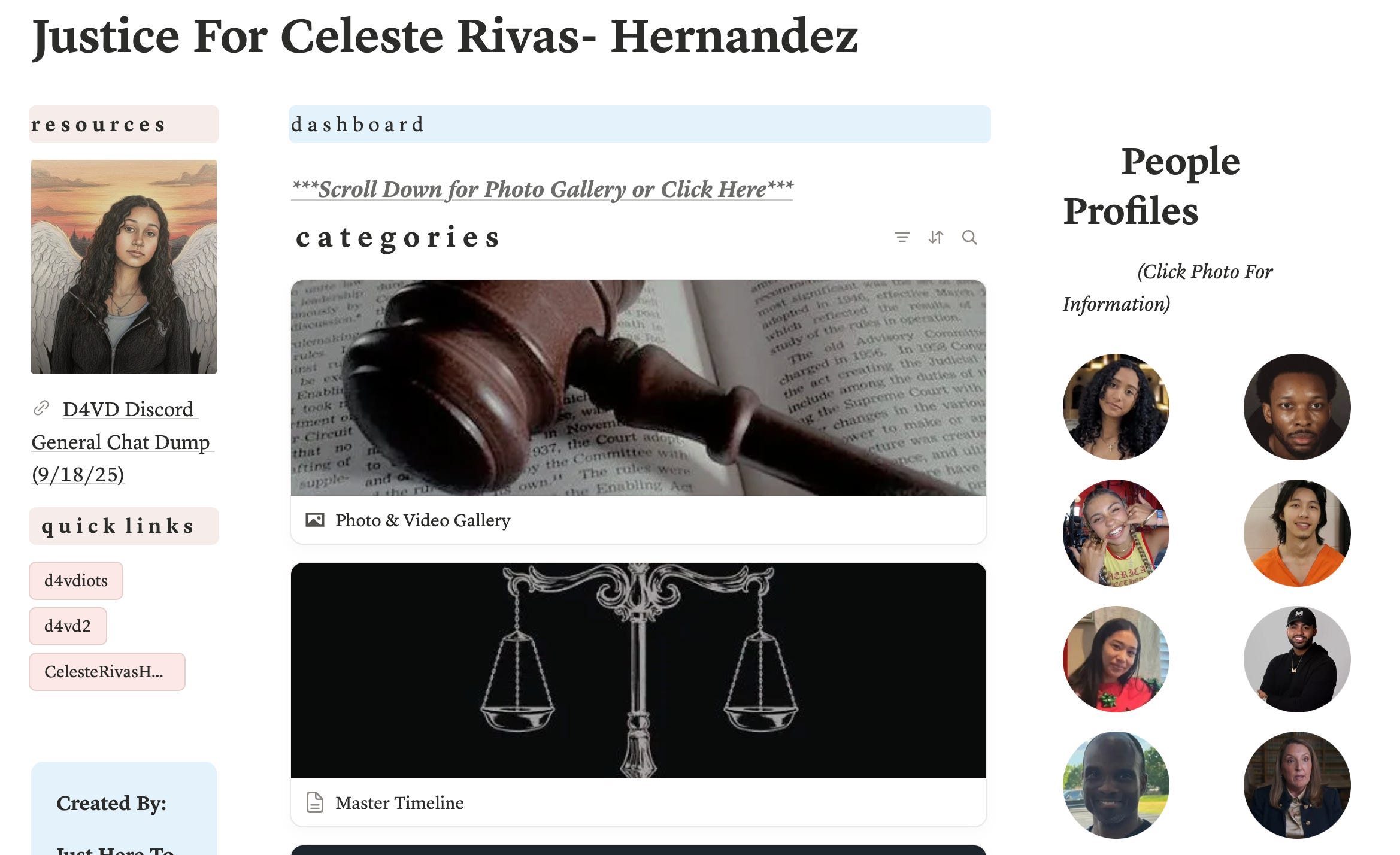
There’s /r/d4vdiots (note the nickname), a public subreddit devoted to tracking the “weirdness” around the musician. There’s another subreddit dedicated to Celeste herself, /r/celesterivashernandez. There’s a Notion document called “Justice for Celeste Rivas Hernandez” that resembles a fan-made wiki. There’s the older /r/d4vd fan community, moderated by Burke, who, some claim, is deleting incriminating posts.
I was first attracted to the case because people were using a combination of tech and the supernatural in attempt to better understand what happened. But the more I learned about what happened, the more I found myself thinking about a different kind of supernatural creature: the Wendigo.
The story of the Wendigo comes from the oral traditions of the Anishinaabe and Cree, Indigenous peoples from across the Great Lakes region and Canada. Depending on the telling, the Wendigo can be an enormous spirit associated with winter starvation, a human being transformed into a monster through cannibalism or greed, or a kind of possession, a person overtaken by an appetite that is so insatiable, they are no longer human. And the more the Wendigo eats, the hungrier it becomes.
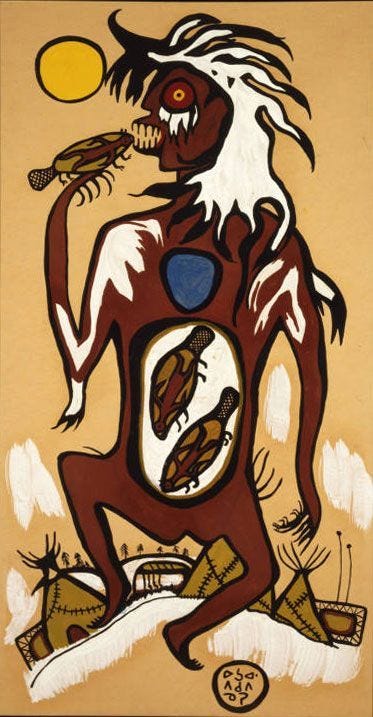
You transform into a Wendigo when you can no longer see how you consumption impacts not only yourself, but your community, that is, when you can no longer see the difference between a person and food.
Let’s return to Burke’s habit of watching gore videos.
When you treat gore as content —- the kind of thing you allow yourself to experience as a never-ending stream — that stream eventually consumes you so completely that it disconnects you from your humanity. Some describe it as an “anesthetizing” effect. Images of death cease to be death, they become something else.
This same logic applies to how people consume true crime. The moment Celeste’s body was found in Burke’s Tesla, people started to pick apart his digital footprint, looking for clues.2 Is that a community coming together to seek justice for a murdered young girl, or is it a gamified form of voyeurism? I happen to think it’s the latter. And as much as I hate to say it, this kind of voyeurism can turn you into a Wendigo, too.
Details, especially graphic ones, at first feel clarifying. The more you know about something, the better you can understand it. But in reality, detail — the decomposition of her body, the manner in which she was murdered — ultimately erases the victim. She is no longer a person, she is an object, created by her murderer and a tool used to understand his psychology. She becomes a detail in a case. In this way, true crime — as a genre, as a community-led game of Clue — murders the victim a second time through its spectacle.
And I think, most importantly, the people who engage in this behavior do, eventually, become numb.
I do not think this knowledge, as it’s actually consumed in podcasts and short-form video and on YouTube, makes us empathize with victims of crime more. There is no interiority — especially not for the victim. If we connect with anyone, it is usually a sociopathic murderer. If we connect with the victim, the most it can ever be is a strange, parasocial fixation, a fixation that will always foreground their murder. True crime stokes our curiosity while asking nothing of us. The lurid details — in picture, in text, in video — are delivered in high volume and with sterility.
And the more we consume, the more we want, even as it destroys us, even as it destroys others.
Just like the Wendigo.
Read my full exploration of the connection between gore videos and the Wendigo here.
In other places, they’re described as having “dated.”
The most perverse version of this ritual is in TCC, the True Crime Community — not the podcast-and-documentary crowd of middle-aged women, but a specific online subculture, incubated on Tumblr, which doesn’t just follow killers but valorizes them and treats them as fan objects similar to celebrities or fictional characters. Several of the people in that community, most famously, Adam Lanza, have gone on to commit homicides themselves.
If you gaze long into an abyss, the abyss also gazes into you.
Incredible article. You really know how to contextualize the world of the digital with hauntingly accurate fairytales, you really get Jungian with it. I was just thinking about this case and how I found myself feeling schadenfreude over the stupidity of the murderer - how satisfying he was caught, how comforting to know he will rot in jail - and then the real unfixable horror of the case set in and I felt that probably I shouldn't spend much more time taking in details