

There’s a Crack in Everything
At Chicago’s ‘Dawn of Digital’ Exhibition

Does the human voice stand a chance?
Confronted with a rapidly undulating ocean of slop, this is a question on many of our minds lately, particularly if we’re involved in the arts. In our darker moments, it sometimes seems like machine-generated noise threatens to swamp the human signal entirely, to bury the distinctly personal in a flood of impersonal chatter. Viewed through these despair-tinted goggles, the future often seems to be one of bots babbling blandly to other bots, like the proverbial tree falling in the woods without anyone to hear it. (I remember being appalled when discovering that the AI-generated band, The Velvet Sundown, came up in the search results before The Velvet Underground after typing “the velvet” into Apple Music.) Most of us are now familiar with how much easier it is to scroll through short-form video than it is to even watch TV or a movie. We recognize our bleak enthrallment.
Searching for a scintilla of hope, I went to the Dawn of Digital exhibition at Chicago’s Publicworks Gallery to chat with musicians and artists and try to discern how they’ve been making their way through this fraught digital environment. I found a heartening combination of opinion: dismissal of AI’s artistic potential along with a certain recognition of its value in practical matters (setting up a business, organizing a calendar, etc.)
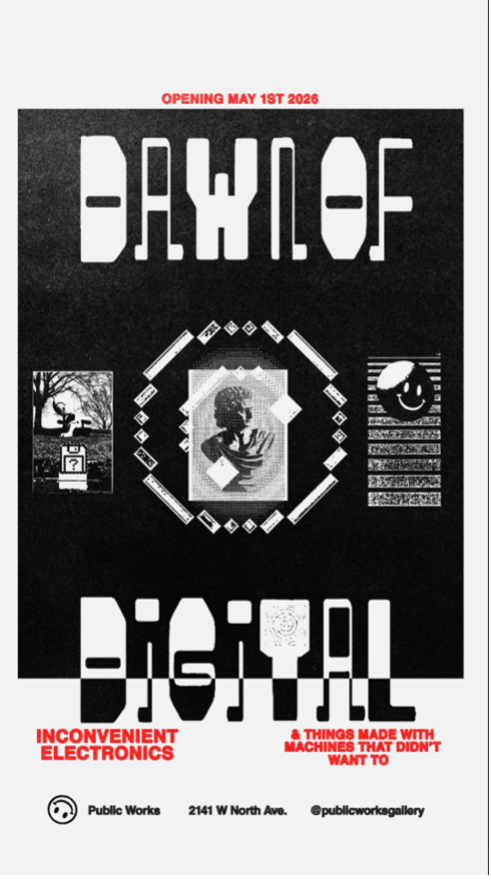
The Dawn of Digital exhibition is related to exploring archaic digital technologies and the art and music made with these clunky artifacts. The theme of the exhibition is “inconvenient electronics and things made with machines that didn’t want to.” Many of the artworks it highlights—visual and sonic—exist at the intersection of analog and digital technology, casting a strange light that mingles the dusk of analog with the digital aurora.
The way digital recording technology functions feels like an allegory for how the world has moved more generally. Digital recording functions by cutting music up into pieces, into bytes, whereas traditional analog methods record the whole sound. They don’t leave anything out. This is why vinyl records have higher fidelity, with the needle flowing over the unbroken groove rather than interpreting a collection of mico-pieces of sonic data. Philosophically, we could argue that the move towards digital constitutes privileging the part over the whole and hence the left brain (which perceives parts) above the right brain (which perceives wholes). The world has grown more technical and hence more obsessed with analysis, with dissection.
Naturally, this acts at cross-purposes with artists, who follow their instincts and intuitions, who trace the flowing line of the whole, as opposed to engaging in the analytical dissection more characteristic of the technical professions (and of editors). But the coldness of digital, its harsh white LED-like glow, can be strategically incorporated to generate a personal and artistic effect.
Over a grapefruit La Crox, I talked to Chris Eichenseer, who runs Publicworks and organized the exhibition. He’s also a photographer, artist, and the founder of Someoddpilot, a creative design agency with an office sitting just above the gallery’s comfortable and spacious locale. (Some of his digital artworks and photos were on display in the exhibition). Someoddpilot has worked on ad campaigns for Saucony, Lollapalooza, and Fjall Raven, among other companies, and was also responsible for the marketing and design of the Pitchfork Festival. Further, it’s connected to a record label and provided the creative and design work for Chicago’s popular venue, Sleeping Village. According to Chris, their approach to ad campaigns involves generating a mythology for the clients, a la Joseph Campbell.
(As if spiritually in tune with the theme of the exhibition, my computer’s recording system immediately glitched and automatically transferred to my phone mic, which recorded part of our conversation in what sounded like the voices of people who had just been huffing helium.)
Chris outlined his vision for the gallery: “I want this place to be where the creatives of Chicago—musicians, artists, painters, animators, and the weird misfit toys—get together.” This involves hosting electronic music shows that appeal to the movement’s more homegrown and indie side. (The gallery recently resurrected Chicago’s trailblazing electronic music series, Play, which runs on a monthly basis). He further expanded on the role of the exhibition: “I think of ‘Dawn of Digital’ as being about this rising new force of good and bad and human displacement/augmentation. Excitement and frustration.”
As the drummer of the metal band Beak, Chris discussed his own experience with using the “inconvenient electronics” in the 90s, particularly the ADAT recording system made by Alesis. While initially appealing because of their convenience and their capacity to make it easier for bands to record at home and independently, these technologies also came freighted with pronounced inconveniences. But, as Chris put it, that was part of their charm:
“It was natural in the mid-nineties to be mixing the world of analog and digital—smearing them together in that decade. So that’s shaped how I think and how a lot of people from that time grew up thinking about themselves. We were very analog on the one hand with the way we grew up, but there were these powerful digital tools. And you want to dive in. But immediately as soon as you’re working with them, you’re compromising and you’re dealing with shit that’s not ideal for the work. It’s something you have to work around, and it presents new opportunities because you’re breaking it and it’s doing cool stuff that you hadn’t understood before…
“You might have a four track or you might have a small tape machine to have multi-track recording at home. That was virtually unheard of [previously]. And then Alesis, which used to make drum machines and outboard audio gear, came out with something called the ADAT, which weirdly enough records onto VHS tapes. So a VHS tape gets shoved in there, and it can put eight tracks of audio across the tape of a VHS cassette. Better yet, you can link it to another ADAT to create 16 tracks and you could get another one that could go up to 32 or 64 total. […] Ween recorded one of their most famous records [Chocolate and Cheese] on ADATs. And they would later regret it because ADAT was such a compromised technology. Me and my friends had scraped enough money together with our various part-time jobs to buy ourselves two ADATs. This was a gift to be able to write and record our own music down in my basement. But quickly it was like—this technology kind of sucks. It was that bad kind of digital. It had some ugly tonal quality to it and [other] limitations…
“That’s been the constant push and pull of it. I think that that ends up inspiring and frustrating people. It’s the inspiration to break it and to use that breakage as the medium and start to have fun with it—with a lot of distortion, a lot of manipulation. It attracts a lot of people, and certainly me and my friends were all really drawn to that. So yeah, convenience. It bites you in the ass. With AI, it’s the convenience of being like: I can just make my own record cover by doing some prompts. It’s too smooth. It’s too quick. There’s something about running into obstacles that’s good, you know. It’s like slow. [...] Giving the final product more detail and edge draws out things that resonate with the human soul.”
Chris’s comments reminded me of the Victorian art critic John Ruskin’s comments on medieval art (as Marshall McLuhan said, “the digital retrieves the medieval”). In Ruskin’s telling, the best medieval artworks are inevitably warped and broken to some extent. This is a feature, not a bug of medieval art. Unlike Greek and Roman architecture, which used slave labor to exactly fulfill the architect’s geometrically perfect plan, medieval cathedrals invited a wide range of anonymous medieval artisans to contribute their own artworks for decorative purposes. The workers weren’t just executing a definite plan, they were letting in the organic and misshapen features of the world, creating something both gnarly and spiritually edifying. “Forget,” as Leonard Cohen sang, “your perfect offering. There’s a crack in everything. That’s how the light gets in.”
At one point, Chris noted of one of the electronic music acts performing at Publicworks: “They’re making drumbeats out of the sounds they hear at Costco. It’s this gorgeous, textured drum rhythm thing going on.” Whether you’re a medieval artist carving a gargoyle or an electronic musician recording sounds at Costco, you’re not playing it safe. You’re aiming for something beyond your capacity, beyond what’s easily achievable and near to hand. You’re trying to exceed your grasp and leave room for the unexpected, for happy accidents.
On a similar note, Chris provided some further detail on the artworks on display at the exhibition, including one of the video installations:
“How can you show the tension that digital relieves or creates itself, or that tension between the analog and the digital where you’re either frustrated or you’re breaking through into something new because of it or in spite of it? We tried to make that work. That’s not the easiest thing to put your finger on. There’s a piece in the show that’s entirely shot on film with a Hasselblad film camera. And there’s nothing about it that’s actually digital. But when you look at the image, it’s completely informed by digital worlds.”
Chris’s insights also put me in mind of something I heard a Catholic priest say once: “The soul likes to go slow.” The inconveniences, the breakages, all help slow you down. If you move too fast in creating art, you lose the space that inspiration requires in order to ferment or marinate. One of the major weaknesses of AI-generated art and music is precisely this. It short-circuits the struggle, resulting in a final product that’s glib and vacuous.
The art at the exhibition very much fit with Chris’s sentiments. The digitally altered images created a sense of the lonely, metallic sweep of the digital, along with accenting a kind of warmth in its earlier manifestations. Images of young computer users messing around on primitive hardware coexisted with visions of digital surveillance at O’Hare airport and a video installation in which you sat on a couch and watched digitally altered footage of a young woman sitting on a couch watching an image of herself sitting on a couch. Eventually, you realized that the couch she’s sitting on is in fact that couch you’re sitting on and this is the same room. Eerie fragments of talk radio clips blared occasionally through the fuzz on the speakers.


After chatting with Chris, I also interviewed Rita Lukea and Tyler Ommen, two of the members of Pixel Grip, a Chicago-based trio who’ve collaborated with Nine Inch Nails and opened for Peaches. They were both playing DJ sets at the exhibition. I asked about their own relationship to technology. Rita responded:
“Everything just evolved so rapidly that we barely had any time with each piece of technology. So I feel like our generation specifically has a fondness and nostalgia for things that existed for a little bit but then immediately became obsolete because technology just moved so fast. I just really love analog and see-through telephones. I barely had that in my childhood, and I just love the look of VHS and how it sounds warm when it’s an older piece of technology. There’s room for both analog and digital.”
Tyler also was admiring of analog qualities: “The analog instruments have the warmth, they have character, they have names, they have their own personalities and history.” He also pointed out that this seems to be related to our affection for puppets from older movies as opposed to their modern CGI incarnations (consider the age-old preference for puppet Yoda over CGI yoda). “The T-Rex in Jurassic Park still looks insane. It terrifying. That’s just a big puppet. It looks incredible.”
When the conversation turned to AI, all of us were in total agreement as to its lack of artistic potential, though it has valuable technical capacities. Tyler pointed out how the new version of Ableton, the recording software popular with electronic musicians, allows you to sample specific parts of tracks more easily. There’s a feature in Ableton Live (demonstrated at the exhibition), which allows you to divide a sample into separate tracks featuring the vocals, drums, bass, and other instruments. Technically, this has been possible for quite a while, but its incorporation into Ableton Live makes it extremely convenient.
When I talked to Chris earlier, he similarly noted that AI can be useful for answering queries related to running a business. But as far as the actual creating of art goes, everyone was clear that it’s consistently insipid and an excuse for not actually expressing yourself. Chris said:
“It’s like displacement. When you drop an object into a tub of water, and once that object starts to fill the tub, all the water’s gonna get pushed out. And AI is like—if we dial up digital so far in that there’s just a thin layer of human left in there, is that more interesting or less interesting? At the moment, it seems like it’s a lot less interesting. 30 years ago, the ratio would have been much different. It might have been 70%, 80% human, 20% digital.”
Rita discussed our intuitive sense that AI is too smooth, empty, slick, and inhuman:
“I was thinking about AI and how humans innately know when something is AI. It’s like when something is so perfect, it’s uncanny. I feel like maybe the reason why we want distortion and analog instruments is because those artifacts are kind of fucked up and distorted and glitchy. So it feels good to the human brain and the human ear. It makes more sense than something that’s super clean. Just metallic perfect. It’s like—mmm, let’s warm this up.”
Tyler added, “It’s like when you get a bullshit fortune cookie that clearly wasn’t written by somebody.”
Rita pointed out that, again, the one thing it’s truly good for is handling the managerial and business-oriented side of things: “I would ask it to compute away. Make me more money maybe. Maximize profit. Not anything artistic though or even psychological—anything that delves into humanity whatsoever. Just anything that’s mathematical.”
This gets at the fact that AI simply deals with the quantitative side of things. Despite the fact that film and music executives seem creepily excited by the idea of phasing out actors and artists, the qualitative is a uniquely human province. And this human specialty is what makes us good at judging how and when to incorporate the digital to create an artistic effect. Chris noted that Trent Reznor from Nine Inch Nails is particularly adept at this:
“He seemed to be a lot more successful at making mainstream hits with his music. When I first heard his guitar sounds in the 90s, they sounded like bad digital distortion. But he was embracing that as a medium. When other people were rejecting it not being analog and thick and warm, he was embracing the thin coldness of it.”
Rita went on to say, “Our use of [technology] as a tool makes it human… It’s like when the light bulb was invented, we didn’t say fuck you to candles. You know what I mean? There are certain things that will never go away.”
She was also enthusiastic about the ways technology can help create community in real life too:
“There’s an argument that contemporary technology has prohibited connection between the artist and the audience. But obviously social media and being able to share things—to rifle up thoughts or inside jokes or captions that make people feel connected… It feels so dumb, and sometimes it is, but people will come up to me and [mention] something that I casually advocated for actually meant a lot to them. You can stand for something, you can be someone, and you can advocate for something. […] People can find their communities, the little tribes, better and faster. I think a lot of that stuff has only promoted community.”
Tyler agreed: “Using it as a tool makes sense, but it’s not a tool to create or finish the art in any form. […] It can be used in good ways, can be used in bad ways. It’s like when people got scared when the computer was invented. People were like, okay, say goodbye to real musicians and drummers. Never happened. Still, you know, we have musicians and drummers.”
We talked about the importance of stylization in finding your voice as a musician. Learning from Peaches and Nine Inch Nails, Rita said, was particularly instructive—receiving in-depth masterclasses from preeminent artists in their fields. “Somebody who’s not afraid to be highly stylized with their art—it just makes me feel so fucking alive. Like Amy Winehouse with her extremely stylized voice or Gorillaz. […] It just feels like bravery. It’s fearlessness to be exactly who you are, uncompromising. Bravery and authenticity creates stylization. It’s not just art, it’s not just your output artistically. It’s also how you live and the things you say and the things you wear. It’s all encompassing.”
I remembered how a friend of mine recently mentioned how hip-hop artists made use of stiff, German techno beats to create something more human and organic feeling. Stylization, again. She said they were “using it as a wall to bounce off.” I think that’s a good metaphor for how the analog relates to the digital as a whole. On its own, the purely digital can feel mechanical, stiff, and dead. But the human touch enlivens it, makes it an extension of our own selves and visions.
After talking to Chris and Pixel Grip, I’m not worried that artists are going to lose their voices in the morass of technology and AI. They’re completely committed to putting out something human and personal through varied forms of tech. The greater worry seems to be that we won’t be able to fish the human voice out of the swamp, that the audience will lose faith in it. Most of us have faith in the artist and in the audience too. But does the music business? That’s the big question, I think. One worries that the executives will be so risk averse that they’ll side with derivative slop, with endless repetitions of what’s already been a sure success. Taking the long view, that seems like a misguided strategy. People are going to get fatigued. The hunger for the authentically new is never satisfied. It will persist.
If the human voice doesn’t stand a chance, it won’t be the human voice’s fault.
 | A guest post by
|
That tv series had some really good digital instruments,...American Horror Story. Synthetic but just effective and interesting plus scary. As a musician im sticking with things with strings or wind or sticks.
Thw comment about not getting to sit with technology resonated in a weird way. I remember playing Pokemon Red in 1997, qnd those 150 little guys felt special. In 2000, they added a few and they were great. By Diamond and Pearl in 2007 I started forgetting a few existed and they started coming more rapidly from there and I couls not tell you anything about most of the newer Pokemon despite playing the games. A kid needs time to sit with them too, and 1000 Pokemon need a lot of time (and I think Nintendo realizes this as they mostly market pokemon from Red and Blue as the franchise faces).