

It's Too Late, Techno-pessimists. We Are As Gods.
I typed this from an iPhone while looking at 3D-renderings of my unborn children.

On April 10, a 20-year-old from Spring, Texas named Daniel Alejandro Moreno-Gama threw a Molotov cocktail at the gate of Sam Altman’s San Francisco home, then walked toward OpenAI’s Mission Bay headquarters and told employees he intended to burn the building down as well. When arrested, Moreno-Gama was carrying a manifesto, a “three-part series,” according to Fox News, that included a list of other AI executives and investors with their home addresses. Then, two nights later, a separate, unrelated pair of people, aged 23 and 25, fired shots at Atlman’s house in a drive-by shooting. OpenAI says the second incident was unrelated to Altman, which may be true or may be what you say when your CEO’s house is firebombed on Friday and shot at Sunday. On Monday, the FBI raided a home in Spring that was connected to Moreno-Gama.

Moreno-Gama used the handle “Butlerian Jihadist” on Discord and Instagram, a term from Frank Herbert’s Dune, which borrows it from Samuel Butler’s 1872 Erewhon, where machines are outlawed because a philosopher argues they will inevitably surpass their makers. He was an active member of PauseAI’s public server, the loose activist network calling for a global moratorium on frontier AI development.
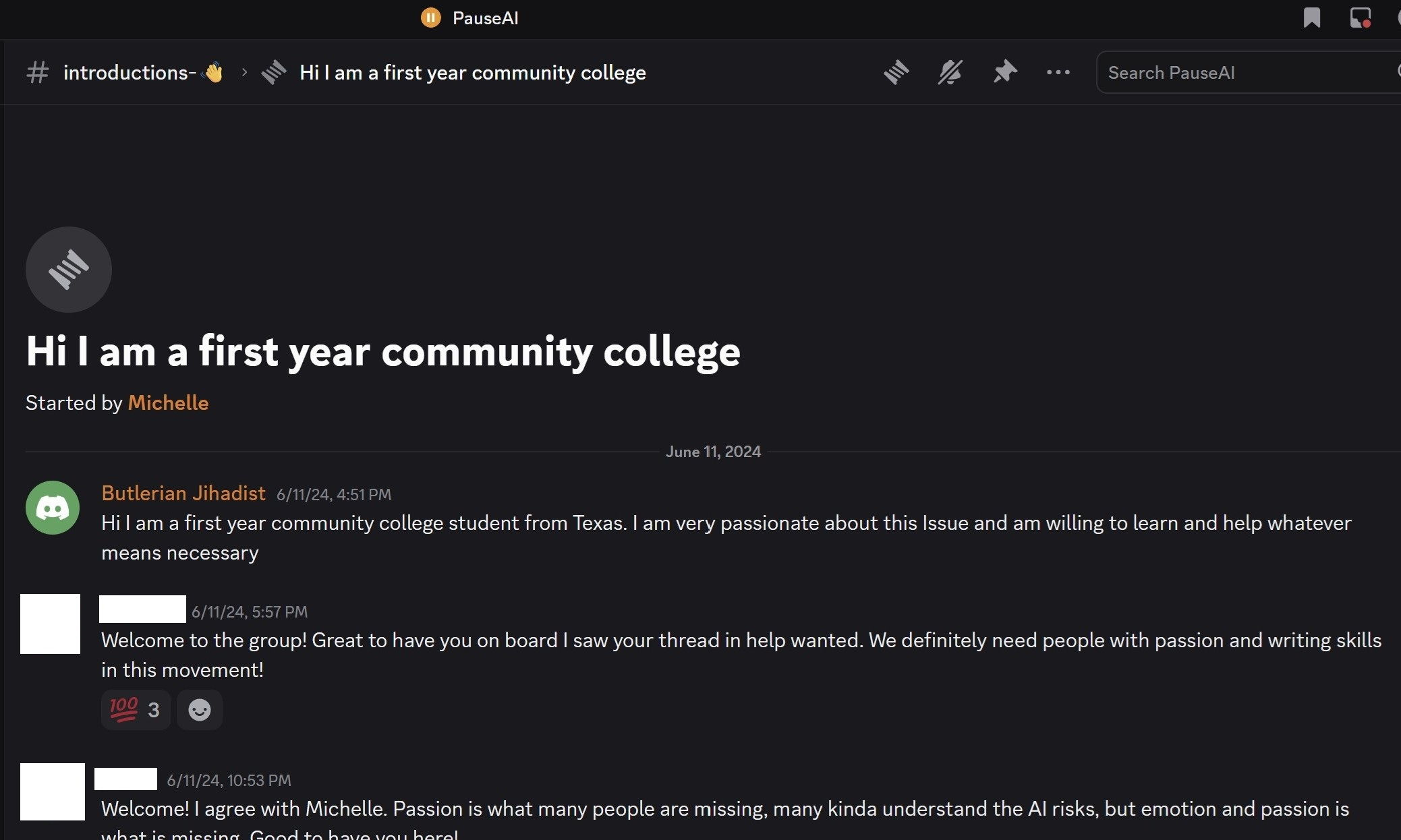

He kept a Substack for several months, publishing half a dozen posts with titles like “A Eulogy for Man,” in which he characterized AI executives as psychopaths gambling with readers’ futures and their children’s lives, and described the arrival of superintelligence as a race to the grave. In December he posted on Discord: “We are close to midnight, it’s time to actually act.” A moderator warned him. Four months before the attack, he recommended Eliezer Yudkowsky and Nate Soares’ If Anyone Builds It, Everyone Dies to his Instagram followers.
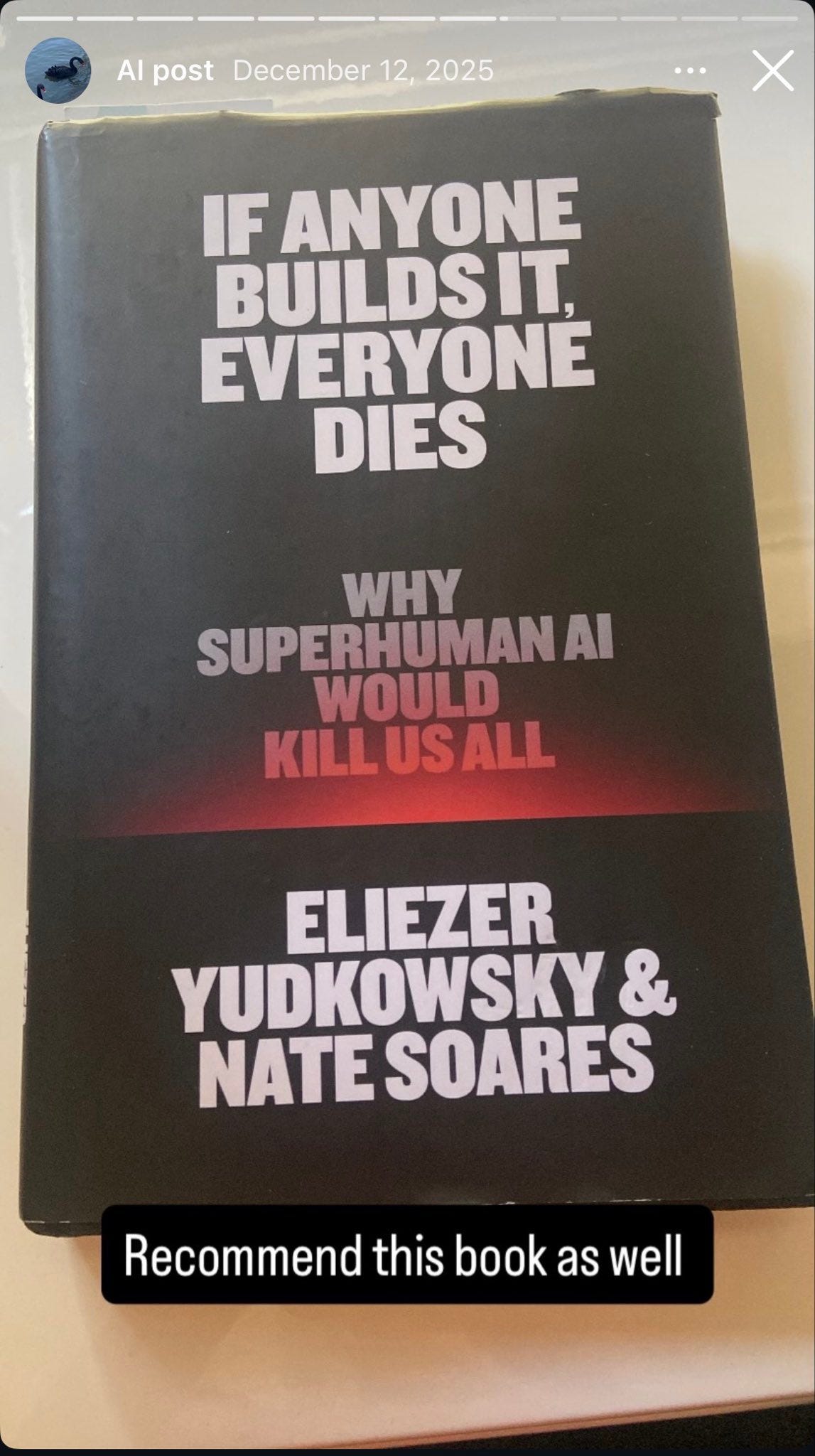
The book argues, “without hyperbole,” that any group on earth that builds artificial superintelligence using current techniques will cause the death of every person on the planet. According to its authors, AI engineers do not know what is inside these systems, cannot inspect the weights in any useful way, and thus cannot guarantee what the thing actually wants. Taken seriously, it is a frightening piece of work.
Ethnography of the wider Rationalist ecosystem aside — where AI apocalypticism is like a goth’s white-powder foundation — the book has been picked up outside its home context and, perhaps, recontextualized as a manifesto. Doomsday scenarios, unfortunately, have a tendency to mutate. Tell a depressed or unstable 20-something, one who may have already been struggling with economic precarity, that the people running the AI labs are going to annihilate his future and that the window for stopping them is closing, and there’s a good chance he’s going to do something about it.
Moreno-Gama’s own writing is Yudkowsky with every caveat deleted and every call for non-violent political organizing ignored. Not a warning transmission from Berkeley; a shot fired from Texas. I don’t believe this is “radicalization,” as some are arguing, at least not in the conventional understanding of the word. But making available — not handing, but not hiding, either — a loaded gun to an already-suicidal person is its own kind of problem, and it is not one that admits of an obvious fix. There are only superficially obvious ones.
I digress.
Jasmine Sun, one of my favorite writers on this subject, has given the phenomenon its best name: “AI populism,” which is when public treats AI not as a technology but as an elite conspiracy against them. I would offer a little color to her description. “AI populism” is more diffuse than any one ideology, and it has been simmering for longer than AI has been the subject. It’s the symptom of something much greater.
What we are watching is a pulse of anti-modernity running through a scattered series of violent incidents.
Most recently: the Palm Springs fertility clinic bombing last May, the Indianapolis shooting last week, both Altman attacks this weekend. It expresses itself in whatever vocabulary happens to be available to the person pulling the trigger. Some call themselves efilists, others Butlerian jihadists. Some leave notes that read NO DATA CENTERS. And some are still worried about climate change, that old frau most of us seem to have forgotten, sweeping her floors, tea going cold and cookies stale.
What is easy to miss, but worth bookmarking, is that the communities these individuals claim tend to disown them or deny affiliation at all. I’d call it damage control if I hadn’t watched the efilists go through the same thing several times already.
These subcultures — ideologies — whatever you want to call them — aren’t organized cells. This isn’t terrorism as we know it. They’re ideas that break containment among a population that already feels hopeless. Efilist forums (the subreddits, the Discord servers) condemned the Palm Springs bombing and the subreddit was purged almost immediately. PauseAI banned Moreno-Gama and said he had never been a formal member. Maybe I am naïve, here. But I think there’s something to it — these aren’t the people you meet at the events. These are the people who pick it up second-hand.
More important than any of that, grief underneath these acts is old and becoming more palpable. Yudkowsky didn’t give birth to Moreno-Gama; the world as it is did. I truly don’t believe you’ll find a murderer at Lighthaven, the Rationalist hub in Berkeley. You might find one lurking on LessWrong without an account — another tab open, maybe about climate change or Palestine or the economy or oil, anomie thick around him.
Whatever the case, progress continues its march.
Techno-pessimists are trying to stop something that has, in most of the ways that matter, already happened. Ray Kurzweil was prescient about many things, and one of them is this: the merger has started. He predicted the outer layers of our neocortex would be wired to the cloud by the 2030s, extending human thought the way the last round of neocortical expansion produced us. But think carefully about what consumer technology alone already does. (And that’s just CONSUMER technology.) We have built ourselves a second nervous system. We are not “building” ourselves a second nervous system. Or: We are already as gods; it’s just that the knowledge of this power hasn’t been evenly distributed yet.
The violence will get worse, and also why it will fail — it is far too aimed at the technology itself. The enemy of the Luddites wasn’t the loom, but rather the factory owners. Yes, AI shouldn’t be used to exploit people and more economic sensitivity in that direction might even diffuse some of the anger. But it is a different fight than the one most of the people reaching for Molotovs think they’re in. They aren’t asking the economic question, or they aren’t asking the economic question primarily. Many of the extremists aren’t asking any question at all — on the surface, they are angry at modernity, at the very essence of technology.
We can change the terms. But we cannot stop the arrival of progress. I hope I am clear: The fight for justice is worth having; the fight against progress is not. You cannot stop where the species is going, only how fast it gets there.
“Everyone dies” is not, from the perspective of most young Americans right now, the worst case. The worst case is everyone lives and nothing you do matters and the job you trained for is gone and nobody will tell you why and the billionaires have bunkers. The anti-natalist who bombs an IVF clinic and the existential-risk boy who firebombs Altman’s house are answering the same question, which is what do you do when life has no meaning? What do you do when you feel like the future has no place for you? I suspect, perhaps controversially, this is what Eric Harris and Dylan Klebold were trying, in their evil, to ask — what Adam Lanza was trying to say in his — what every man who “went postal” was trying to say.
Violence will only widen the divide. Some will move toward Kurzweil. Others, Kaczynski. The rest remain in purgatory, in neither one camp nor the other. The doomers will produce more Moreno-Gamas.
But I want to shake them and tell them we’re already the world of tomorrow.
In 2020, I said the real culture war was about technology. This has been true, arguably, since agriculture, since the alphabet, since reading, since the printing press, since the Industrial Revolution. Mary Harrington has since argued the singularity has already happened. Mary is right.
The revolution you are waiting for is over, and you are, for better and for worse, one of its children.
AI is a symptom of the deepening monetary sickness of fiat currency that has been going on since Nixon abandoned the gold peg.
Under quantitative easing, the American economy runs on the principle of “the Fed creates trillions of paper dollars out of thin air —> gives it to their friends.” Without this extremely perverse (and undoubtedly soon to expire) economic system, I doubt AI companies would be economically viable.
I can't tell you how many times I've said, only half-kidding, "It's over," in response to an AI-related story from the past year. It's the serious half that I think about most.
Today, right now, AI doomerism still seems like an overreaction to most people. Even people who understand it intellectually believe that we'll always have some kind of fail-safe, or that it will always remain a mere tool, just as every invention up to now has been. But guns and bombs are also tools. So is social media. Something being a "tool" doesn't preclude it from being destructive.
And, even more, AI and related technologies seem *qualitatively* different from everything that has led up to this moment--even when compared to something as transformative as the World Wide Web or the transistor radio, for example.
Which is why, this logic goes, we must have a fail-safe. But there can be no fail-safe against human nature. The desire for more. More progress. More exploration. More money.
So, today, right now, we find ourselves in a fleeting moment when the novelty and possibility of AI drowns out the deceptive murmur of its most frightening aspects. I know it will likely virtually eliminate my entire *sector* within a decade. Long before then, it will profoundly change it. Perhaps within two years (this part has already begun).
Yet, at the same time, I love making silly little 10-to-20-second videos to taunt and amuse the members of my fantasy football league.
I, too, am human.
Thus, knowing full well my own grave lies under my feet, I continue to shovel.