

Drifting, Falling, Floating Weightless, Calling Home
the first newsletter back since i became a mommy of three

You’re reading default.blog, an emotional scrapbook of the internet, technology, and the future. This is my first newsletter out since I had my twins, an excerpt of a piece I wrote about my hometown, Boca Raton, Florida, for The Dispatch.
Our regular programming will return soon.
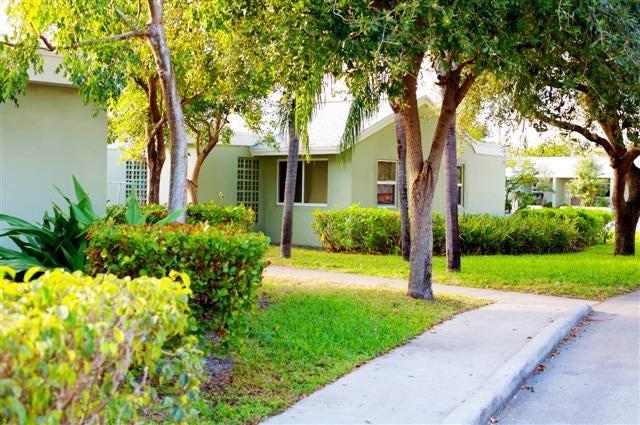
In the 2010s, South Florida was a man.
He was shirtless and burned pink, with fried blond hair, and he had maybe just tried to rob a gas station naked, high on bath salts, which, to this day, I still picture as a bag of Dr. Teal’s. South Florida was an alligator in a swimming pool, it was the world’s Walmart; it was always lurid and disgustingly humid, something dirty and diseased that lived on the chyron of the national news. But the South Florida I am from, Boca Raton, cordons itself off from that Florida. The one I grew up in was sterile and refrigerated, air conditioned down to the temperature of a morgue, so that to come in from the heat is to feel yourself go cold and stiff, so cold that you are always a little bit still, as though you had just been laid out for viewing on a cool metal table. Boca Raton is suspended in formaldehyde and the rest of the state grows mold.
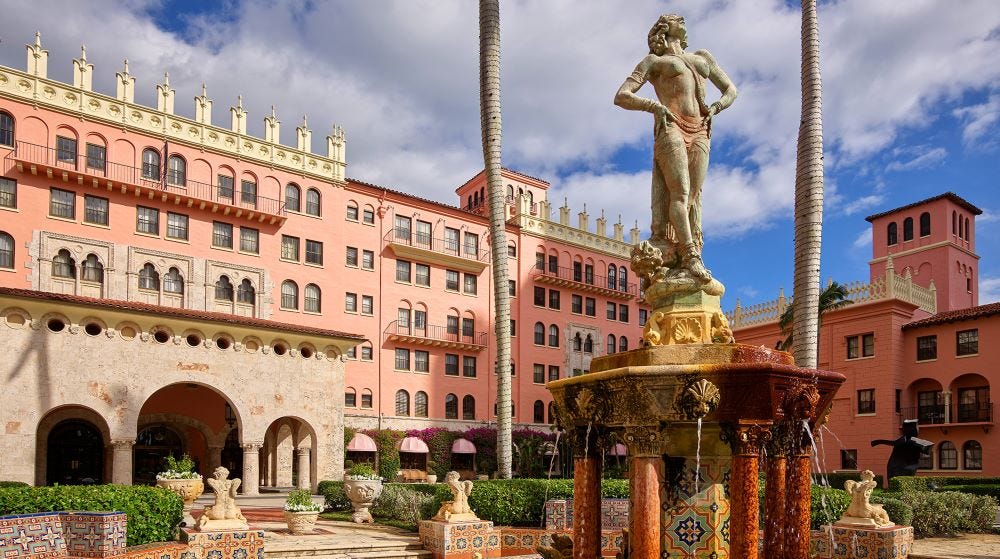
Boca Raton has its myths.
There is Addison Mizner, the architect who in the ‘20s imagined pink stucco and Spanish arches, the great dream of a Mediterranean oasis for people who had never seen the Mediterranean. And before him there were the Yamato colonists, the Japanese farmers who came at the start of the century to grow pineapples out of the sand and who are gone now. All that remains of them is Yamato Road and a wilting Japanese garden. But most of Boca went up fast, in a sonic boom of the ’80s and ’90, the swamp drained and everything built in a hurry, so that almost no building in Boca Raton is older than my mother, and my father, who died in one of these white, sterile rooms himself, the air conditioning turned down to 59.
The oldest living things in Boca Raton are first the alligators, who were here before the gated communities and the guardhouses and who respect neither of them, and second, the philanthropists, whose names are stamped across wings of $70,000-a-year private schools like Saint Andrew’s and Pine Crest. The swamp is still down there under everything; every so often water seeps up through the grass. The roads run three, four, five, six lanes wide and are lined the entire way with shopping plazas built around a Publix, and the plazas repeat faithfully, the same pastel pink and yellow stucco and the same green awnings and the same Publix beside the same nail salon beside the same Walgreens that used to be an Eckerd, so that you can drive 20 minutes in a straight line and arrive back exactly where you started.
Boca Raton has long been called God’s waiting room, and the name is not a joke.

Congratulations on your new kids!
Oh, and nice Peter Schilling reference. GenX approved.
congrats on your twins! and I know they say it to the point of meaninglessness, but truly: drink it all in; it goes by so fast.